Consumer Electronics Packaging and Wrap Rage

New York Times has an article about amazon.com’s battle against consumer “Wrap Rage” – the frustrating experience of unpacking stuff that you buy from them.

Wrap rage by Amazon
I have long been amazed at how stupid packaging has gotten, especially for small electronic items that are sold in transparent clamshell type packing which is very convenient for retailers to display, but require industrial shears to cut away. I love what amazon.com is doing. It not only addresses “wrap rage” but also cuts down on waste. The packing material is less in quantity and is both recycled and recyclable. It costs less for the manufacturer. The box that carries the item can be smaller which saves money for Amazon. All in all it is good for consumers, for the manufacturers, for amazon and for the planet. So shouldn’t it be a roaring success?

Apparently not. From the same Times article

Environmental experts attribute the slow response to the intransigence of big manufacturers, the complexity in having different packages for physical retail and electronic retail and a lack of coordination among the major e-commerce companies.

While this implies that the manufacturers are intransigent, the real problem is that retailers still want the pretty clam shell packs. Their stores are designed so that those batteries can be hung on hooks, looking pretty while providing consumers easy access to them. Let’s call this the “display value” of merchandise.

My first job after business school was at a consumer marketing company and I saw the impact of display first hand. In Indian kirana stores in the early 90s it worked. Better displayed brands sold better. But in 2010, in the US, I believe the value of display is overestimated. Retailers haven’t adjusted to consumer behavior.

Consumers don’t just walk around a store and buy a Philips electric shaver on impulse. They know they need one and they research it – on the internet, ask friends on Facebook – before they decide which one to buy. When they come into the store they know exactly what they want to buy. Maybe they have a question or two to ask of the store sales rep. Otherwise they just take the shaver and go.

There are shades of grey of course. What I am saying is that today, when a product is likely to have been researched to death outside the store, the “display value” of that product matters less. Much less that what retailers think it does. But I will also admit that “display value” for many products has not dropped to zero. I do get reminded that I need AA batteries when I walk past them in the grocery checkout line. And that is worth something to the retailer.

But I don’t think that the trade-off between display value and consumer frustration with packaging is being made correctly today.

Let me give you another example. I just started going to a different grocery store because their produce is better. Now, most grocery store layouts have a certain macro level logic to it. But when it comes down to looking for Rice Milk or something like that, I am rendered completely helpless. Like most males, I hate asking for directions. Until I am forced to, which is like after 15 minutes and two trips across the length of the floor.

Wouldn’t it be easy for the store to put up kiosks in the store and even something on their website, where you could check availability and location of a certain product? Its probably the most obvious solution to a common problem. But the store won’t do it. Why? I’m now guessing here, but I’ll bet it is because they believe that if I wander through their aisles looking for Rice Milk I am likely to pick up a few more things that catch my eye (essentially another form of “display value”).

One day, retailers will make that trade-off between display value and security on the one hand and customer frustration on the other and come up with some solutions. Perhaps display things whichever way you want to but sell things in friendlier packaging. Until that day arrives, I’ll shop with amazon.com thank you very much.
The Cost of Onsite Hiring Just Went Down

The US Southwest Border Bill imposes an increased application fee of an additional $2000 for every H1B and L1 employee on a few Indian Offshore Services companies. Much has already been said about it by politicians, Indian companies and NASSCOM. [NY Times, Hindu]

In early July I had written a piece on the challenges of Local Hiring or onsite hiring. In it I wrote

Also, there is the issue of optics. Can you do X billion dollars of business in a country, with tens of thousands of employees in the country and hire just a handful from the local market? The law may allow it, but you have to do much more in the court of public opinion.

Little did I know that Senator Schumer was actually planning to change the law itself.

But perhaps this will be the turning point for onsite hiring. There are other good reasons to increase onsite hiring. Again, from my post

Going forward, local hiring will become more important. Winning business is now less about technical expertise, which is assumed. It is about domain expertise – do you understand my business process well enough? It is going to be pretty tough to build domain expertise organically – through the work the company does for clients. Hiring industry expertise into the company either from industry or from other consulting companies will become necessary to compete.

Indian Balance of Payments and Offshore Services

The RBI is concerned about India’s Balance of Payments. One of the reasons ascribed to the growing problem is the slow down in the Indian Offshore Services industry. From today’s FT

One reason, the central bank said, for the deterioration in the balance of payments was a decline in an “invisibles surplus”, caused in part by falling revenues to India’s prized outsourcing sector.

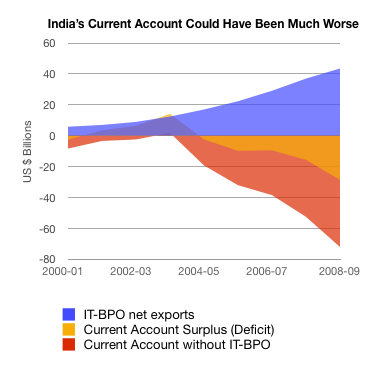
For my book I crunched some data from the RBI website. As you can see, on the Current Account, India depends a whole lot on the Offshore industry.

Without the Offshore industry being where it is today, the import regime could not have been as easy as it is today.

But I am a little confused on the timing of this. Given that last quarter was very good for most of the top companies, isn’t this now no longer a concern? Or is it that RBI data gathering and analysis lags public companies announcing their results by a quarter?

Real estate prices in India and California

Real estate in India looks really inflated to me. Two data points – one in Mumbai on very expensive flat in South Mumbai and another on a more modest flat in the Chennai. The annual rent on both is between 1.5 and 2% of the price of the flat. Yields on Indian government 10 year notes, is currently close to 8%.

One can draw two conclusions from this:

– It is far, far better to rent than to buy real estate in India. On a 2 cr. apartment the difference between buy vs rent is 12 lakhs per annum (and the peace of mind that GoI bonds give you)

– People who buy real estate at these prices are counting on capital appreciation and definitely not rental income. How much higher can it get?

On the other hand, in So Cal, a friend who thinks it is a good time to buy real estate in California, is making 8-10% just on rent (after costs).

Maybe those Mumbai fat cats should think about investing in California real estate. A much better long term bet, good rental yields and easy to manage long-distance.

I wonder if there is the makings of a business in channeling this investment from emerging markets with super high real estate prices to developed economies where post the financial crisis, real estate is quite depressed.

Indian Traffic – An Illustrated Guide

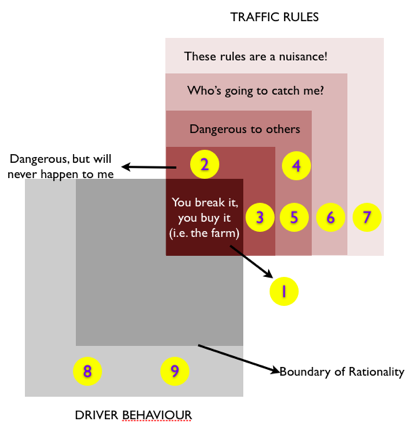
You break it, you buy the farm

Breaking these rules have a high probability of death or serious injury to self or car

1/ Stop at a red light, especially when there is cross traffic.

Dangerous, but it will never happen to me

Breaking these rules can cause death or serious injury but the event carries a low probability

2/ Wearing a seat belt in the front seat
3/ Not driving on the wrong side of a divided highway even if the U turn is more than 20 m. away

Dangerous to others (but not to self, although a car wash may be necessary)

4/ Stopping at Stop signs
5/ Stopping at pedestrian crossings (instead of speeding up) even when some pedestrians start sprinting across

Who’s going to catch me?

Pesky rules that are unnecessary. Break them if you can get away with it.

6/ Not using your cellphone without handsfree, especially when a cop is present.

These rules are a nuisance! (thank God there is no enforcement!)

7/ Using your horn only when necessary

Much of Driver Behaviour is not governed by Traffic Rules. But even there there is behavior that is rational, and behavior that is not.

8/ Praying to the gods to keep you safe before (or while) breaking rules 2 to 6.
9/ Leaning on your horn a few seconds before the light turns green.

Of Leaking Electricity

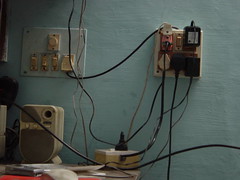
My Dad's wiring!
Have you noticed how in India if you visit your friends or family, you always need their help to turn the TV or computer on in the morning? Why? Because it is too darned complicated. For instance, to turn on the computer you may need to switch on some or all of the following:

– Wall socket
– UPS
– Power strip
– Second wall socket (because the power strip doesn’t have enough outlets)
– Computer
– Monitor

Yesterday I was being brave at my parents’ house and decided to try turning on the computer myself. I went down the checklist and turned on the computer, but the broadband modem wouldn’t turn on. After many minutes of jiggling wires and testing for loose connections I finally discovered this small button on the back panel of the modem – another switch – and of course it had been switched off.

Its almost as if we revel in taking something simple like switching on the TV and and making a sacred ritual out of it – a complicated series of actions which cannot be executed without rigorous training and is designed to obfuscate outsiders.

I used to find this exasperating until I got interested in clean tech last year. It turns out that the Indian approach to turning off power to appliances that are idle actually does save electricity. It probably also extends the life of the appliances, though I haven’t read any research on that.

In the US on the other hand, there is almost no attention paid to what is called “standby power” – the power consumption by appliances, especially modern, intelligent electronic appliances, when they are idle but not turned off. Standby power is a big source of lost energy. Lawrence Berkeley Labs has a website dedicated to educating the public about standby power. According to them, a typical American home spends as much as 10% of its power consumption on standby power.

Typical American attitudes to switching off stuff are that they a) don’t want to be bothered about it and b) find it funny when someone does it. As far back as 1933, James Thurber, in one of my favorite funny books, My Life and Hard Times, describes his mother’s paranoia

… mother lived the latter years of her life in the horrible suspicion that electricity was dripping invisibly all over the house.

because of which she would go around turning switches off all over the house even if there was nothing plugged into them.

I suspect most Indians won’t find this funny. Switching off stuff comes naturally to them. And if a good percentage of them don’t know that electric current doesn’t flow unless the circuit is completed, that’s natural. The other thing that is “piped” into the home is water and that drips all the time.

On the other hand, I don’t know if too many Americans find this funny either. If two thirds of them believe that Obama is a Muslim and a whole bunch of others hold these kooky beliefs I think there must be a lot of people like Thurber’s mother out there.

Android India

For the last two quarters Android has outsold iPhones in the US. It has real momentum behind it. All carriers in the US offer multiple Android smartphones and the rate at which new ones are being introduced can be only described as a frenzy.

I think Android can conquer the Indian smartphone market. There are many, many things going in its favor. Android is supported by Google but is open source and free. India is a price sensitive market. Apple’s options are fairly limited with the price of an iPhone being what it is. You’ll find corporate bigwigs and finance types carrying an iPhone but really, with a $500+ price tag without a contract, it is just too expensive. So unless Apple introduces an “emerging market” iPhone model it has no hope.

And I don’t think that will happen. They’ll be too concerned about reverse flow of cheap, unlocked iPhones back into developed markets. In any case, Apple is used to being the BMW/Mercedes of consumer tech. They can’t play the emerging markets game. Also, they have no or little support infrastructure in India.

The only potential problem I can foresee is if the hardware spec for running Android becomes too expensive. As an OS matures it gathers features and bloats. But Google seems to have thought of that. Froyo, which is the latest version, is supposed to be highly performance-tuned and could even run on the first generation G1 hardware (I am considering it for my G1). Spice announced their Android phone range today. The entry level Mi 300 is priced at Rs. 10,000. That is a very nice starting point. Expect prices to go down from there.

So if you have a mobile apps strategy in India, better start thinking Android. And Nokia should see the writing on the wall and go Android.

Another Perfect Notebook

I went to Odyssey in Chennai last week. I like to go to the stationery section in the book store. You never know what you’ll find.

This time I found a handy little notebook. I like notebooks. I know people who will take notes in a meeting on their laptops, some even on their handhelds. I just can’t. So I always carry a notebook around. This one is from a company called Kaapy (couldn’t locate the website). It has about 80 pages of good quality paper. The hard cover has a nice distinctive, monochrome graphic on it. Not too flashy, but not too plain either. The best thing about it is that it is light weight and just the right size to fit into your pocket.

It costs Rs. 36. I know this price can’t last, so I bought 6 of them.

A few years ago I wrote about another notebook from Rubberband. Strangely, that slim, stylish notebook was not carried by Odyssey. Instead they had a fat, ugly looking notebook which seemed to be a special edition notebook in collaboration with some movie. It cost some godawful amount that I can’t recall. Why would Rubberband do this and who are the people who buy this one, escapes me.

I guess notebooks are a little like companies. With success, they bloat and raise their prices.

Survey Results Analysis

I promised to share the survey results. So here goes. The sample size for all responses fell between 68 and 77. Which is a pretty decent sample size.

Interaction with the blog


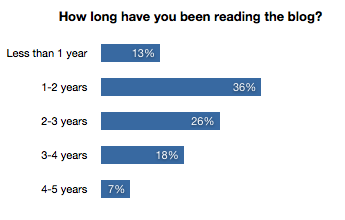
A large portion of the sample don’t remember when they started reading the blog – which probably means that they have been reading it for more than a couple of years. But there does seem to be a significant percentage of relatively new readers. I like that. If I were a business I would want to both retain old customers but also keep getting new customers.


Readership on the website is surprisingly high. Just shows how even a tech savvy audience can differ in their preferences. Case in point is actually my own family. Vidya, my wife, is an avid reader and has more blogs bookmarked in her browser than I have in my feed reader. She prefers going to the websites. I prefer my Google Reader.

About the Reader

Only 4% of the sample was female. A little disappointing. I thought I was more popular with the ladies 🙂

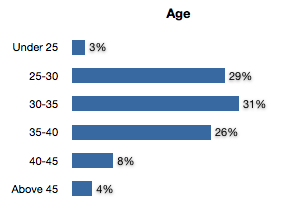
The age profile of the readers is well distributed.

97% of the readers grew up in India. Given my background and the things I write about, it is not surprising. The blog probably does get hits from a whole bunch of non-Indians but they are going there essentially to read a particular post, or because they were searching for something specific, not because they are regular readers.

56% of readers live in India. 36% in the United States.

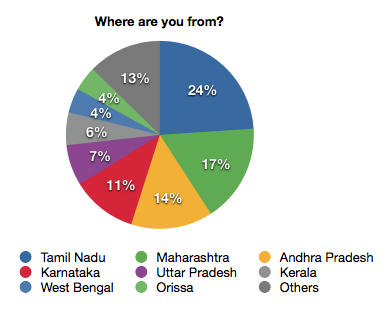
The “home state” question turned up interesting results.

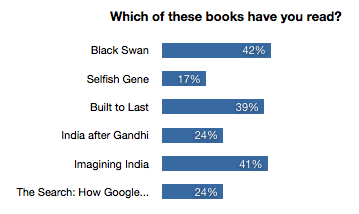
I asked the books question for a reason. Instead of asking the question “What subjects are you interested in?” I asked if readers had read books that indicated interest in the subject. There was no book on Offshore Services (until we write ours ;-D) so I picked Nandan Nilekani’s book as a proxy.

I guess nothing was surprising. Except perhaps the percentage of readers who have read Black Swan. But it is heartening to know that my readers are a bunch with varied interests.

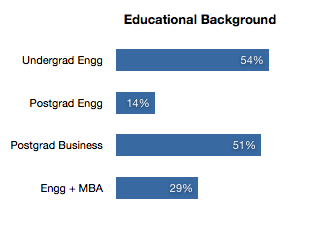
Lot’s of engineers among my readers. Not surprising. A lot of MBAs too. Nice. But then that’s what I am.

The industry of employment also held no surprises. Management Consulting was not one of the choices. Perhaps it should have been.

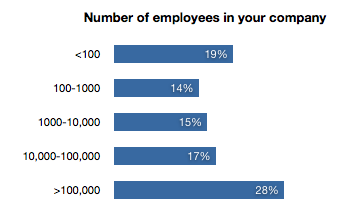
Readers are well distributed across startups, small companies and big companies. The above 100,000 is overweight probably because of old friends from Infosys.

The qualitative feedback was in general positive and encouraging. Many of you wanted a higher frequency of posting and more engagement through comments. Also, more on the future of IT Services, entrepreneurship, balancing work and creative pursuits, life of a global Indian etc. Very good suggestions.

Time constraints get in the way of posting oftener, also because I tend to write long posts. I have started tweeting actively now, which allows me to have a short message outlet and I can also share interesting readings. My twitter handle is @basabp

Commenting is something I have gotten better at, I think. But I comment where I can achieve something in a short comment. Sometimes readers leave open-ended questions in the comments. I can’t always respond to them, but if someone else can, you are welcome to. I will be delighted if the comments section becomes a forum for the interchange of ideas with a very light touch from me. Many successful bloggers like Matt Yglesias have achieved that.

Thanks to all of you who took the time to respond. The survey is now closed.

Chennai Expressway Threatens the Beaches

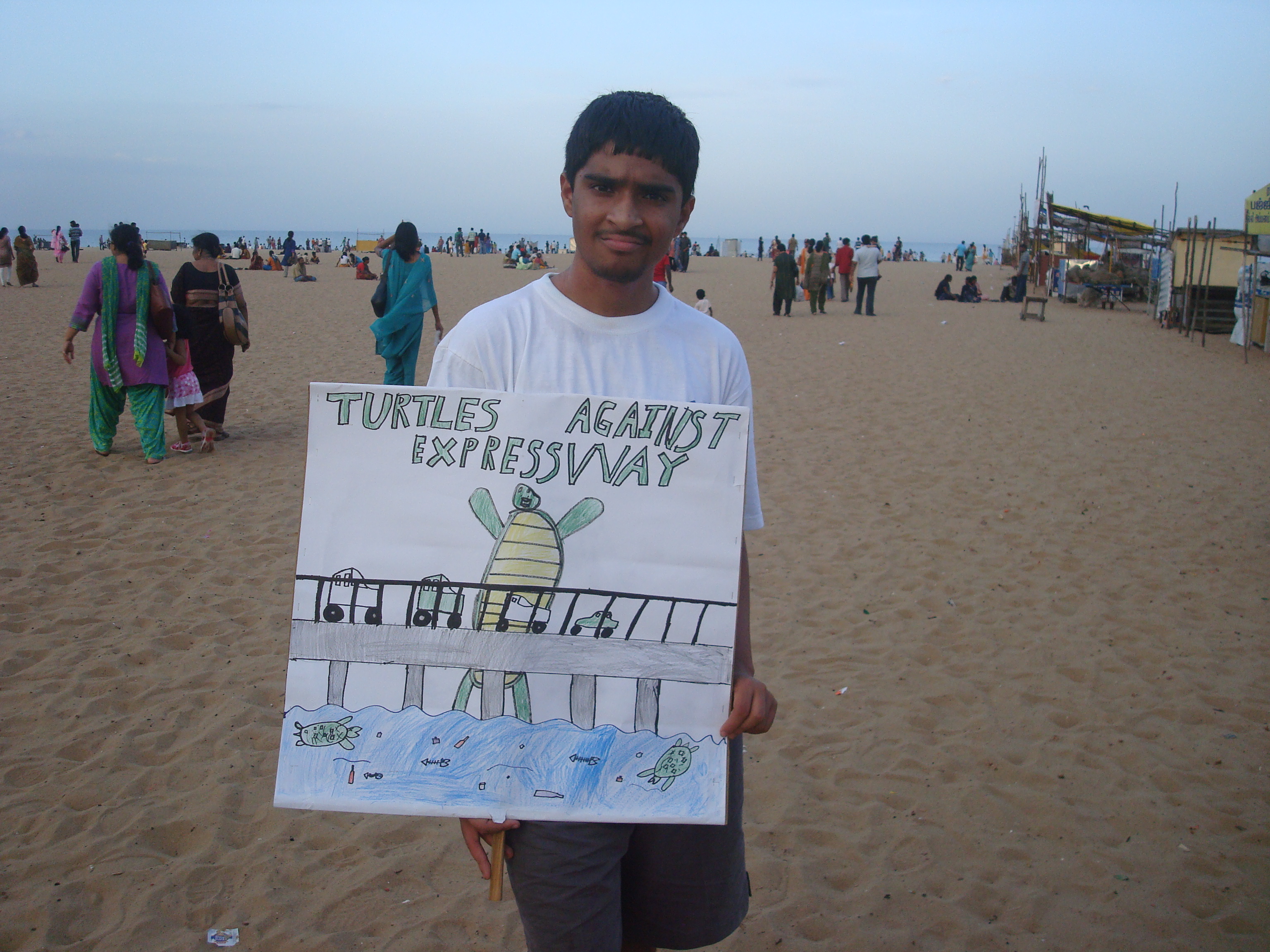
Son Naren Pradhan has been having a pretty interesting few weeks in Chennai. He is interning at the Tree Foundation a non-profit committed to environmental education and conservation. Protecting sea turtles is a focus area for the Foundation. Naren spends his time caring for the turtles and writing about them and the Chennai wetlands.

Last year Naren got involved in the effort to stop the construction of an elevated expressway along the coast line in Chennai through an organization called Reclaim Our Beaches. There was a protest rally on the Besant Nagar beach on July 31. Protestors were encouraged to bring their own placards. Naren’s “Turtlezilla” placard was a big hit. The Hindu covered the protest here.

A mega project like the Chennai expressway can have wide ranging impact. The affected include displaced fishermen, marine life and citizens who use the beaches.

The success of a civic protest can often hinge on effective images and symbols. The oil spill in the Gulf of Mexico coincidentally has an impact that is quite similar though much larger – it affects the livelihoods of fishermen and destroys the coastal ecosystem. The most striking images of the disaster have to be those of birds covered in oil. I wonder what would be the most effective images for the narrative in the Chennai expressway protests.

The Chennai expressway protests have a “disadvantage” when compared to the BP oil disaster. The expressway hasn’t been built yet. And you can’t wait for that – once it is built it will be too late. So the key “marketing” challenge is how to paint a picture right now, of what is going to happen if it is built. For the opposition to become a grassroots movement, the public needs to see in their mind’s eye what is going to happen. The fear and concern that will follow is what the movement will feed on. The Hindu article for example, has a beautiful photo of the Marina beach. If I was new to the issue I would have to read the whole article carefully to form an opinion. If like people, I didn’t read it, I would carry the image of a serene beach in my head!

Words don’t travel as well as pictures do.