The Cloud and Services

Reflection of clouds on Soap Lake
Yesterday, IBM put its cloud services under its Services arm. It will be sold by IBM Global Services. From the FT:

In its latest revamp, IBM said it would sell cloud computing through its services division, which generates nearly 60 per cent of its revenues.

This could be a defensive move to shore up IBM Global Services. IBM’s latest quarter was a good one with the sole exception of contract signings, which were down. IBM waved it away as something caused once in a while by lumpy contracts. But the fact is that customers aren’t doing big, long-term contracts the way they used to. They like smaller, flexible contracts. Applications outsourcing is definitely going that way. Ask TPI.

On the other hand, this doesn’t have to be a defensive move. It could be a brilliant, strategic move that gives them the edge in selling cloud services in a rapidly commoditizing market.

From offshore services companies, I hear a similar equivocation about cloud services. Some think that it is a threat, some think its an opportunity.

Cloud services are a long-term threat to ERP implementation revenues. Compare the implementation revenues from a salesforce.com implementation with a Siebel implementation. Revenues from Salesforce.com implementation and ongoing support (what’s that?) are tiny in comparison. Companies are willing to greatly simplify their own processes to fit the box that salesforce.com gives them. If that happened to all ERP implementations and support services, that won’t be good news for IT Services companies. This may take a decade to play out, but the trend has begun.

On the other hand moving a company’s infrastructure to the cloud, public and private, is a pretty interesting services opportunity.

But this threat/opportunity picture misses the woods for the trees. In the long-term, the cloud is going to be the biggest thing that happens to Services. Not IT Services specifically but outsourcing of services in general.

Outsourcing of services was enabled by enterprise IT and the internet. Before that, you couldn’t take the accounts payable guy away from the accounts payable office where he would cut checks based on paper invoices. Accounts payable and workflow systems and then networking and the internet allowed someone to perform the same function remotely. Today broadband is cheap and ubiquitous and the same job can be done offshore. In a way, enterprise IT systems and the internet started loosening internal services performed by employees from their moorings within the company.

The shift to the cloud is going to wrench them loose and finish the job. If companies can put their accounts payable system on multi-tenant SaaS, what reason could they have for performing the accounts payable function themselves?

The opportunity for Services companies will move from IT Services to business process platforms – a system and the service on top to perform a business function with standardized, well defined inputs and outputs. Much like how payroll services work today. The process will be fairly standardized, and the reason why companies will “settle” for a standardized process will be that the cycle time and cost of doing so will be so, so low that they would be stupid not to.

Why will the cost be so, so low? Because of multi-tenant SaaS, efficient, standardized processes and offshore wages.

The opportunity is massive, but business as usual won’t deliver the goods for services companies. Not this time, because they will face a new competitor – software companies. Today SaaS companies are essentially software companies, that rent software instead of selling it. Soon they’ll wise up and see the opportunity in providing a full solution. Or they’ll create an ecosystem of small service providers around them like Intuit has done in the small business market.

It’s going to be a brave new world for Services companies. But only the innovative will thrive.

Direct Flight Envy

Jet Airways, one of my favourite airlines is heavily promoting a direct flight from New York (Newark airport) to Mumbai. A friend who lives in Chicago and travels to India often was quite pleased with American Airlines’ direct flight to Delhi. American Airlines flies directly from Chicago to New Delhi. Flying time each way is between 15 and 16 hours. Compared to the 25 hours that I am used to on Cathay from SFO, even with a good connection in HongKong, that is travel nirvana.

I did some research on ClearTrip on the subject. There are nine direct flights between the US and India. All of them are from the New York area and Chicago to either Delhi or Mumbai. Either city in India works for me to land in. But there are no direct flights out of San Francisco. Bummer.

https://spreadsheets.google.com/pub?key=0AhacLyA6cF2-dHg0TXFnd0FmM1c0M1pOd2g0Ml9VVnc&hl=en&single=true&gid=0&range=a1%3Af6&output=html&widget=true

Why aren’t there direct flights out of San Francisco. Distance obviously isn’t the problem. New York to Bombay is 12, 500 km. San Francisco to Delhi is 12,360 km. So the distance that a plane can travel without refueling is obviously is not the problem.

The distances are as the crow flies and were computed here.

It can’t be a problem of no-fly zones either. That is to say, the shortest route involves flying over countries that won’t allow you to, so you have to alter the flight path to an extent where it becomes too long. The San Francisco to Mumbai shortest path essentially flies over Russia and China.

So then it must be about the San Francisco Bay Area market. Will they be able to fill seats on a direct flight to India from SFO? I find it hard to believe that Chicago can be a bigger destination than San Francisco. There’s a large Indian population in both metro areas, but the Bay Area has to be bigger by a wide margin. More businesses in the Bay Area – all the tech companies – do business in India than out of Chicago. Tech companies are both interested in the Indian market as well as India as an outsourcing/backoffice destination.

I hope some airline will stand up and admit that they have tarried too long on San Francisco and quickly inaugurate a direct flight to India. Someone was about to do it before the recession, so it isn’t entirely inconceivable.

Failure 2 Communicate

We’ll be going to see a very interesting play this weekend in San Francisco called Failure 2 Communicate. The play is written by Valerie Fachman and directed by Scott Baker. Valerie describes the play

Based on my work experience in Chicago, this play immerses the audience in a maelstrom where autistic teens are forced into high school classes with gang bangers, while the teachers try to channel this chaos into an education.

Good friend Nandini Minocha is in the play as well.

The play is also trying to raise a modest amount of money to cover costs and such. If Autism or supporting the arts is something you consider a worthy cause, I hope you will be generous.

Open Toolbox – Blogging etc.

tools that I use since my move to the Mac. At that time there were some requests to write about blogging tools. Since I know many of my readers have their own blog, or at least often think about starting one, this post will be about blogging tools.

I use WordPress hosted on Siteground. This is different from the wordpress.com website. If you are starting out, I would strongly recommend going with wordpress.com or a similar service. When I got my son Naren started out with his blog I opted for the free version of wordpress.com. When I started blogging in 2005, I opted for typepad’s similar service.

But I soon started hitting roadblocks. It wouldn’t let me do this or that. Completely understandable for a multi-tenant SaaS business model, but it didn’t work for me. So I moved my blog and all its content to a self-installed, self-managed WordPress implementation. At that time WordPress wasn’t as evolved as it is today and on a day to day basis I had to muck around with filezilla a lot. I don’t miss that at all.

I am on WordPress 3.x now. I can’t recommend WordPress enough. It manages to be feature rich, extensible and rock solid at the same time. I have also run my company website on WordPress where it played a combined blog-cum-CMS role and it did quite well.

Yesterday, I cut over to a new WP Theme. It is the official theme from WordPress itself called Twenty Ten. It is clean, elegant and works for me. I like stuff to be simple. Fancy features that get in the way, don’t last too long with me (although, I am a sucker for trying them out!).

I know how to make changes to the CSS and templates and have done so extensively to my older themes. But in general, you don’t want to go overboard there. Customizations to software take time and effort to make and maintain. Plus they make the website unstable. So far I have made just one CSS change to Twenty Ten. I hope I can keep it down low for a long time.

The header image, by the way, is of a sunrise at Mendocino, California. The photo credit is in the footer.

Plugins are what make WordPress extensible. I use several. And there are many more that I have used, but don’t anymore.

To control comment spam I use both Akismet and Bad Behavior. Even then, a lot of it gets through. Recently, I have started seeing comments that are clearly being written by a human being. I believe these services are being offered out of India. Comments with link backs are supposed to raise the Google rank of the websites they are promoting. I guess its a legitimate business. I just wish the comments made more sense. I just delete them.

I use plugins for Archives (Smart Archives), Google Analytics (Google Analyticator), Feedburner (Feedburner Feedsmith) and Sharing (Share This). Since most of my readers read my blog in an RSS Reader, I tinker around with Feedburner a bit too.

For Twitter, which I have started in earnest only recently, I found a pretty good plugin (or set of plugins) called Twitter Tools. Every blog post automatically goes out as a Tweet. Also, on a weekly basis, the week’s Tweets are posted to my blog. My Twitter handle btw is @basabp

For my Contact Form, I used the plugin Contact Form ][ for a while and it works fine. But I love Wufoo for forms of every kind. So my current Contact Me form is from Wufoo. It is not a plugin it needs to be embedded into the page.

I used Intense Debate for comments for a long time. I haven’t been happy with it. But the theme I was using till yesterday did not support nested comments. Yesterday, I retired Intense Debate after moving to my new theme. The social networking aspect of Intense Debate is bunkum. Nobody cares if your comments are aggregated across the blogosphere. Plus they seem to have lost on market share to Disqus anyway.

I used Gravatars for a while too, separately, and then because it was built into Intense Debate. But my readers are not the types to have gravatars. So instead of having empty boxes all over the comments section, I just discarded it.

Another thing that went away yesterday was the related posts that you saw at the end of every post. These related posts were generated automatically by a plugin called Yet Another Related Posts Plugin. It worked well. But I don’t know if people noticed it or found the suggestions useful. At times, the suggestions degraded to where they were just visual noise. I might bring it back, but for right now its inactive.

I tend to write long essay-like blog posts, sometimes over multiple sittings. I could do that in WordPress – the Admin panel is pretty easy to use and auto saves. Actually, it is worth mentioning that the WordPress Admin is one of the best designed pieces of complex software that I have used. Thanks to Happy Cog.

Anyway, I got into the habit of writing up my blog posts in Evernote before I bring them over to WordPress. Evernote takes care of the auto save, and the archival to the cloud, in case something were to happen to my WordPress database.

I use images frequently, for which I use Skitch – free image manipulation software for the Mac.

Would love to hear from other bloggers out there who run their own blog.

The Yin and Yang of HR in Services Companies

I will start out saying something provocative, but true nonetheless. There are just two key elements in making a Services company successful – Leadership and the HR function. The company that does better on both these elements, wins. In the best companies HR will excel at hiring, training and motivating employees. The company leadership decides on strategy which determines how to deploy these employees to generate the best returns for shareholders. It also promotes, recruits and motivates the team that runs the company. Together, better Leadership and better HR, separate the winners from the rest.
Which is why the CEOs of services companies should pay a lot of attention to the HR function and the executive who runs HR for them. The job of running HR for a services company is tough, complex and requires an almost impossible combination of skills.

The scale at which Indian services companies operate, in some respects, has not been seen anywhere in the world. A few of them have more than 100,000 employees, which is huge but nowhere near the largest employers in the world like Walmart. But if you take recruitment numbers they start looking scary – on a 100,000 employee base if you grow by 20% and attrition is 15%, both very conservative numbers, you are still looking at hiring 35,000 employees this year. I can’t think of any centralized recruitment operation with that kind of hiring. Maybe some of the Chinese contract manufacturers like Foxconn. Companies like Walmart, with 2.1 million employees, might hire more people in a year but for them recruitment is very decentralized. It is an ongoing process that is handled at the store level because the recruitment is going to be from the nearby area only.

Even outside recruitment, other processes like appraisals, are now operating at a scale that is achieved by only a handful of global companies. A company like Infosys at 120,000 employees will have practically every employee go through a single, centralized appraisal process and system. A global company like GE with over 300,000 employees will likely have a multitude of appraisal systems that differ by business, country and class of worker.

With this kind of scale, HR bosses have to run very tight processes for everything from recruitment to appraisals to separations and everything between. These processes have to be efficient, effective and must run on applications which allow it to scale without breaking down. A candidate or an employee is a “widget” that flows through a “supply chain” and an “employee life cycle”. How do you standardize around a set of processes and build supporting systems that allow higher throughput (100,000 employees growing at 20% a year) and reduced cycle times (start and finish appraisals, promotions and increments within 3 months)? HR Heads who possess “systems thinking” will come out ahead on this front.

On the other hand, HR teams must continue to play the traditional HR role – be the via media between management and employees. Be there to protect, represent and sometimes just listen to employees. An employee is an emotional being who can produce fantastic work if he is motivated. And who can drag down the morale of everyone around him if he is demotivated. Salaries matter when deciding whether to stay or leave a company. But other things matter too. Investment in training and growth. Quality of work. A pleasant, non-hostile work environment. A boss who knows what it means to be a boss. Bonds of friendship and trust. Only an empathetic HR function can work towards creating this environment for their employees.

Successful HR heads must have both empathy and systems thinking. It’s a tough ask. But as the recent quarter is showing us, the industry is still in a high growth phase. Which means that the HR function has never been more important that it is today.

Currency Wars and India

Prime Minister Manmohan Singh in an interview to FT has said that he is “worried about the global situation” over rebalancing the global economy.

At the heart of the matter is what can be called currency warfare. Money is cheap in the western world. It seeks better returns. Better returns are in emerging growing markets like India and China. These countries are seeing huge capital inflows which put pressure on the currency.

China manages its currency. It is more or less pegged to the dollar and moves in a narrow range. This creates balance sheet issues for China – they need to keep sucking up dollars from the market, and buying US Treasuries with them, that offer low returns. But at least they protect their export competitiveness.

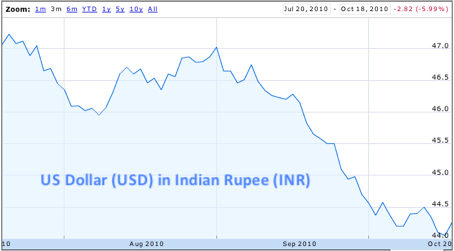
India on the other hand uses a much lighter touch on the rupee. Since September, the rupee has appreciated from 47 to nearly 44 rupees to the dollar. That has a tremendous impact on the profits and competitiveness of exporters like the Services industry.

Essentially, India is getting squeezed between an undervalued Renminbi and cheap money in the west.

I have never understood why informed opinion in the US defends the Chinese on this issue. Its not so much defending them as much as deflecting the criticism by saying “The Renminbi is not the problem. The US should look at itself to see what ails it – why are its students falling behind on Science and Math scores, what can it do to make its workers upskill etc. etc.” Which is hogwash. Yes, the US needs to look at these fundamental matters, but that’s not an argument for why the Renminbi should be undervalued.

None of this makes sense until you realize how much stuff big business in America manufactures or buys from China. Why would they want their dollar cost of imports to rise? US jobs be damned.

Some people argue that even if the Chinese loosened their grip on the Renminbi, and it rose say 10% overnight, it’s not as if jobs would whoosh back to the US. The difference in labor costs and the all-in cost of manufacturing is just too high.

So the undervalued Renminbi makes no difference to jobs in the US. But it does make a big difference to India. And other low cost manufacturing countries in Asia like Vietnam and Bangladesh. A fairly priced RMB could make India a very competitive destination for manufacturing.

Next month’s G-20 summit will see a lot of hot air, but almost certainly, no solution to this global quandary. The China-US game has reached a stalemate. India unfortunately is paying the price.

Where Will the Good Jobs Come From

Yglesias rebuts Ed Luce in the FT.

First, Ed Luce:

…a paradigm that has outlived its usefulness – the view that globalisation is an unmixed blessing for the US economy, and that America’s disappearing manufacturing jobs will be replaced by high-value jobs in the service sector. Things do not appear to be working out that way.

Take Applied Materials, a big US manufacturing company, which earlier this year shifted its chief technology officer and research and development operations to China. The company said it needed its R&D to be close to the source of its manufacturing operations and to its biggest future market. This is the opposite of what is supposed to happen. America was meant to keep the high-end jobs at home, while China would get all the low-value added production.

Yglesias rebuts:

In addition to my oft-made point that US manufacturing output is not in fact declining, it’s worth noting that the alleged need for R&D to be proximate to manufacturing options (plausible) cuts in both directions. Conventional wisdom is that manufacturing operations will all drift to low-wage countries. But if the USA is a better location for R&D than China, and if it’s strongly desirable to co-locate R&D and manufacturing operations, then many firms will want to retain manufacturing operations in the United States of America. So if this story is right, then more and better education for America is the key to retaining high-wage manufacturing jobs.

A few general remarks.

One, in my opinion, R&D’s proximity to manufacturing is less important than its proximity to the customer. In the case of Applied Materials, they mention both proximity to “manufacturing operations and to its biggest future market” as the reason for moving R&D to China. Luce and Yglesias pick up on one (manufacturing), but not the the other one (markets) which is probably the stronger driver. From the software industry we know that offshoring development (akin to manufacturing) while keeping design and product management in the US, is now more the norm than the exception.

Two, the US is unlikely to lose its edge on R&D. It has the biggest market by far in the world for anything and therefore the biggest playground for innovators in the world. It also has a lot of other things – the best talent from around the world, great universities, protection of intellectual property, venture capital etc. etc. Much has been said about the advantage that the US has in R&D. Now, in any market, new entrants will always be able to chip away at the leader’s share, just by positioning themselves to do something that the leader can’t do or won’t do. But even if some R&D goes to China and India, it won’t be of a magnitude that can impact the US hegemony over R&D.

R&D is not an end in itself. It is a means to an end. R&D itself creates millions of jobs but you have to have an advanced degree in Science or Engineering to get one of those. Not everyone will get (or want) a job like this. If the US continues to preserve and grow “innovation” related jobs, that is good, but not quite enough. Where are the millions of middle class American jobs going to come from?

This is a serious problem. The future of globalization might depend upon it. When manufacturing started moving to China, services jobs took their place. They were well paying (and a lot more comfortable). As now more and more of the white collar services jobs are being offshored as well, where will those middle class jobs come from?

Richard Florida might have the answer.

Among the fastest-growing jobs categories, according to the BLS, are what are called personal services – everything from day care and elder care to home health aides, food preparation, hair-cutting, home maintenance, and the like. These jobs are nearly impossible to offshore as they involve direct face-to-face human contact. A key platform in a national jobs strategy must include increasing the quality of these currently low-paying service jobs, turning them into higher-paying, family-supporting jobs.

Florida also says that these jobs have seen very, very little investment in technology and skills. Jobs pay better if they require higher grade skills. Jobs require grade skills if they are complex and need the use of tools and technology. Higher productivity can enable higher wages. Higher productivity requires the use of technology.

Rumored Candidates for NEC Director

Candidates being suggested to replace Larry Summers as Director of the National Economic Council – basically, the President’s top economic advisor – include Indra Nooyi and Diana Farrell.

Indra Nooyi is one of the many CEOs whose name is being heard as candidates. On the one hand this would correct a certain absence of people with experience in the private sector, in the Obama administration. On the other, the NEC Director is really a job for an economist. So we’ll see.

Another candidate is Diana Farrell who is currently one of the two Deputy Directors in the NEC. In the past she has been Director of McKinsey Global Institute, McKinsey’s research arm. While she was there she researched and wrote extensively on Offshoring and global labour markets.

Acquisitions in the Offshore Industry

Horses for Sources has a post on the rumored merger discussions between Cognizant and Genpact. Financial Express reported on it first. I disagree with the premise of the post and wrote a long comment which for some reason did not post to the blog. So I am reproducing it here at the end of the post. (Note to self: always write long comments in a notepad before you post them.)

First let’s look at what could be the rationale for an acquisition in the Offshore industry. To my mind there are four models that justify an acquisition. They are not mutually exclusive and most acquisitions may be classified under multiple models.

1. Acquiring Offshore Capability

The legacy model of IT Services and BPO is no longer viable. Whatever remains is crumbling under the weight of offshore economics. It has taken over a decade to do so, but most of the major players – IBM, Accenture, Cap Gemini, Unisys – have all set up, with varying degrees of success, India and other low cost country capabilities. On the way, some of them took the opportunity to acquire an Indian company. IBM acquired Daksh and EDS acquired Mphasis. I see acquisitions in this model continuing as promoters in smaller Indian companies becoming more willing to deal.

2. Market Footprint expansion – Geo, Vertical

These will typically be small, tuck-in acquisitions. You could be buying a point presence in a geo or a vertical where you see potential but don’t have a foothold. Infosys’s acquisition of Expert Systems in Australia would be in this category.

3. Service/Solution expansion

TCS’s acquisition of Citi Global Services gave them a solid capability in BPO in Financial Services. HCL’s Axon acquisition would be in this category as well.

4. Scalar expansion

Acquiring a company similar in most respects to your company would fall under this category. Tech Mahindra’s acquisition of Satyam and Caritor’s acquisition of Keane would be called scalar acquisitions. I call them scalar, because the rationale behind them is to scale the company. I believe that there hasn’t been enough of this kind of consolidation and that this is coming soon to the industry. My earlier post gives the reasons why.

One model that is conceivable but I don’t hold out much hope for is where an Indian services company acquires a major consulting led company. I just think the integration is too tricky and the risk of flight of talent is very real. HCL Axon approaches this model, but Axon while reasonably large was a very focused SAP consulting and services company and SAP was never HCL’s strong suit. So they can effectively carry on doing what each of them was doing pre-merger and avoid any integration whatsoever.

This may look like the same combination as 1) above, but it is not. If a major global player acquires a mid-sized Indian company they will operate it purely for offshore capability. All market based roles and leadership roles in the company will be retained by the acquirer. But when an Indian services company acquires a consulting company, it is not clear who will lead and who will follow. And that is what will lead to trouble.

Onwards to the possibility of a Cognizant-Genpact combination. Why might this be a very good combination? Here are my reasons:

The businesses are very complementary. Genpact is less than 15% IT Services. Cognizant is 5% BPO. The lack of overlap means a few things, all of them major factors:

  • In one stroke Cognizant as the acquirer becomes one of the largest and most sophisticated BPO service providers. In addition to already being a large high-growth IT Service providers.
  • One of the worries in Services acquisitions is that you will end up offering the same services at the same clients at different rates and then the client will move all services to the lower of the two rates. That overlap is going to be minimal in this case.
  • The senior teams of both companies will find homes in the combined company. In the medium term they should not have to merge leadership of business units.

Horses for Sources (HfS) says that the BPO culture is quite different from the IT Services culture and that will not bode well for a merger. I can’t see why they would think this. Both companies have a dynamic, growth-oriented culture and have professional management.

HfS thinks that Indian companies have used cash for acquisitions and Cognizant doesn’t have enough cash to acquire Genpact. Indian companies have used cash so far for acquisitions because they have enough cash – actually more cash than they know what to do with. This cash expands the balance sheet and lowers investors’ return on capital. Companies like Infosys have done several special dividends to reduce cash. Nobody in their right minds would use stock to acquire when they have that much cash sitting around.

Does that mean that they won’t use stock when they have to? Absolutely not. I don’t think Genpact’s investors would have any problem accepting CTSH stock.

Also, on a related matter, both Genpact and Cognizant are listed in the US with no float in India. This makes things easier. Acquiring a company 100% in India is a little messier, procedurally.

The fact that GE is 40% of Genpact’s revenue is known and will be priced in to the acquisition price, post due diligence.

The rumor may or may not be true and even if it is true, the deal may or may not happen. But on the face of it, it makes sense. The combined company will be on target to be the second largest in the Offshore industry after TCS within less than a year based upon projected growth rates. And in this industry size matters.

The Long Backlash Against Offshore

The US and Western Europe account for the lion’s share of the market for Offshore services. In the medium term they are expecting slow or no growth and at least in the US, high unemployment rates.

In such a scenario, we should expect that the public opinion will turn against offshore. Naturally therefore, the anti-offshore rhetoric in the media and from politicians will ratchet up.

In the past, the polemic against “offshoring of jobs” at the national scene has generally focused on China and the loss of manufacturing jobs in the US. The reasons for this are:

– The impact of Chinese manufacturing on US jobs preceded Offshore services outsourcing by almost a decade. The magnitude of the impact was also much larger.

– Loss of manufacturing jobs is a union issue. The Dems are extremely sensitive to union issues, especially in the Rust Belt (which became rusty because of Chinese outsourcing).

– The early impact of Offshore services was on IT workers. And for a while the impact was softened because of the growth in the IT sector. The employment in the sector grew so much till the tech bubble burst, that it easily absorbed both domestic workers and outsourcing.

– IT Workers were typically better educated and higher paid. If they failed to find another job, they had a college degree and would be able to find some other form of employment. Probably lower paying but they wouldn’t be without a job for too long.

But things are different now.

Chinese manufacturing still has a much bigger impact. Which is why there is so much angst in the US about China’s pegged currency rates (which is deserved, IMO). But there are other things that are different this time around.

First, the impact of Offshore services is slowly veering away from IT workers to regular white collar workers – from customer service to business analysts. Many of them don’t have a college degree and don’t have flexible skills.

Second, while the US was losing manufacturing jobs to China, the service jobs were picking up the slack. Over a couple of decades, the composition of the US workforce shifted dramatically to where services jobs accounted for the bulk of the workforce. Now as services jobs slowly start leaking out to India, there is no mega trend to rescue it. To make things worse, unemployment is expected to stay close to 10% for a while.

As you might expect, the backlash has begun. There was the Borders Bill. Then state governments, who are incidentally running budget deficits, have started barring government outsourcing to include any offshore component.

From the NY Times article on the Border Bill

“I’m thrilled that these companies are complaining about having to hire more Americans,” said Senator Claire McCaskill, Democrat of Missouri. “That is the whipped cream and cherry on top of this sundae.”

Indian services companies run the risk of becoming punching bags for American politicians. Unless they do something about it.

The first thing you need to do if you are responsible for your company’s response to the backlash, is to be clear about your own position. Offshore services may be called outsourcing. It may be that you can point to the guy in India who took away a specific American’s job. But despite all this, Offshore services is no different from trade in merchandise of any kind. Offshore is trade in services. Keep repeating that sound bite. If people attack Offshore, they are anti-trade.

This is not about twisting facts to make a bad situation look good. It is in fact exactly right. Which is why no economist worth his salt will stand up and say that the US should place restrictions on Offshore services. Because it is trade. And unlike Keynes, there are no economists contesting Ricardo.

Next, talk about all the American goods that Indians consume. From Nike shoes to Cisco routers. I haven’t confirmed this yet, but someone I spoke to today said that India-US trade ran a deficit on the Indian side after accounting for services.

Then, talk about the fact that there is a shortage of IT workers in the US. Unemployment may be at 9%, but that doesn’t mean that unemployment among college educated software engineers is anywhere close to that. This does sidestep the issue of the impact of BPO but if you had the aggregate numbers I am sure one could craft a response there as well.

Finally, craft a coordinated PR plan through an industry body. Don’t just sit back and let the media and politicians control the message. Some of this seems to be happening as is evident from this article in the FT where both Infosys and Cognizant are quoted.

The action above should be happening in the media and in meetings with clients and, importantly, employees. Employees who are onsite meeting clients are often asked these questions by concerned client managers. If they are armed with the right messages and data, they can handle these questions much better.

Another important area of action is to influence governments. I doubt if lobbying US legislators is going to go too far, at least in this charged atmosphere. But it does help to at least have industry body representatives get their point of views in front of legislators.

On the other hand, lobbying the Indian government to take action is likely to be very effective. India and the US have a special relationship. Neither side will want a trade war and will work to avoid a situation where India does a tit-for-tat targeted tax on consumer products from companies which are majority owned by a US company.

Lastly, the best friends of Indian Offshore companies are American corporations. They like the cost, flexibility and availability of talent in India. They are global corporations and believe in open markets. They would love to do more business in the Indian market. And they have leverage with US lawmakers.

Outside the US market, the UK market is going to follow a similar pattern. Outside the US and the UK, the stakes are anyway smaller. The environment is going to get tougher and more unfriendly to Offshore over time if things don’t improve unemployment wise. It’s important to stay focused on this matter and be proactive. Damage control after a bill like the Borders Bill, achieves very little.

[Update: For completeness’ sake, I must mention that the most important action point perhaps is to actually hire more Americans. Or Britishers. There are Indian companies who seem to be doing that with some success. An earlier post on local hiring.]