Survey Results Analysis

I promised to share the survey results. So here goes. The sample size for all responses fell between 68 and 77. Which is a pretty decent sample size.

Interaction with the blog
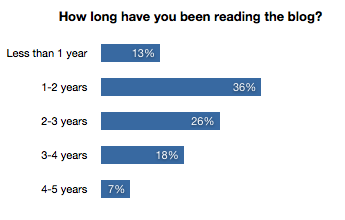

A large portion of the sample don’t remember when they started reading the blog – which probably means that they have been reading it for more than a couple of years. But there does seem to be a significant percentage of relatively new readers. I like that. If I were a business I would want to both retain old customers but also keep getting new customers.


Readership on the website is surprisingly high. Just shows how even a tech savvy audience can differ in their preferences. Case in point is actually my own family. Vidya, my wife, is an avid reader and has more blogs bookmarked in her browser than I have in my feed reader. She prefers going to the websites. I prefer my Google Reader.

About the Reader

Only 4% of the sample was female. A little disappointing. I thought I was more popular with the ladies 🙂

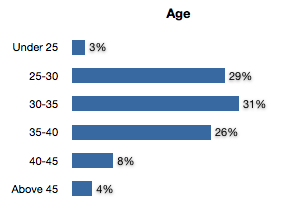
The age profile of the readers is well distributed.
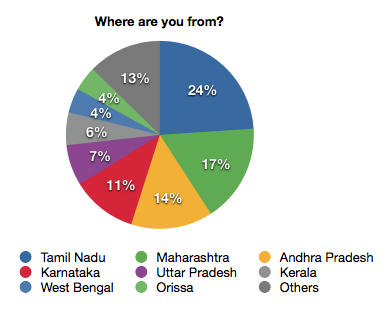
97% of the readers grew up in India. Given my background and the things I write about, it is not surprising. The blog probably does get hits from a whole bunch of non-Indians but they are going there essentially to read a particular post, or because they were searching for something specific, not because they are regular readers.

56% of readers live in India. 36% in the United States.

The “home state” question turned up interesting results.
I asked the books question for a reason. Instead of asking the question “What subjects are you interested in?” I asked if readers had read books that indicated interest in the subject. There was no book on Offshore Services (until we write ours ;-D) so I picked Nandan Nilekani’s book as a proxy.
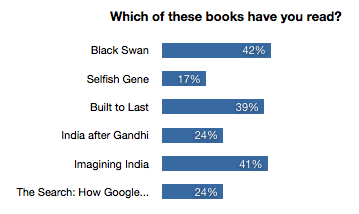
I guess nothing was surprising. Except perhaps the percentage of readers who have read Black Swan. But it is heartening to know that my readers are a bunch with varied interests.
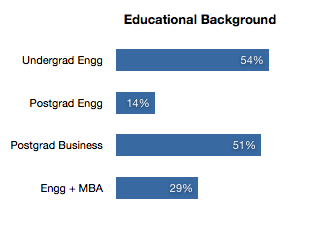
Lot’s of engineers among my readers. Not surprising. A lot of MBAs too. Nice. But then that’s what I am.

The industry of employment also held no surprises. Management Consulting was not one of the choices. Perhaps it should have been.
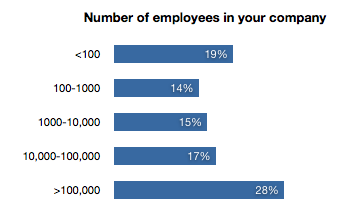
Readers are well distributed across startups, small companies and big companies. The above 100,000 is overweight probably because of old friends from Infosys.

The qualitative feedback was in general positive and encouraging. Many of you wanted a higher frequency of posting and more engagement through comments. Also, more on the future of IT Services, entrepreneurship, balancing work and creative pursuits, life of a global Indian etc. Very good suggestions.

Time constraints get in the way of posting oftener, also because I tend to write long posts. I have started tweeting actively now, which allows me to have a short message outlet and I can also share interesting readings. My twitter handle is @basabp

Commenting is something I have gotten better at, I think. But I comment where I can achieve something in a short comment. Sometimes readers leave open-ended questions in the comments. I can’t always respond to them, but if someone else can, you are welcome to. I will be delighted if the comments section becomes a forum for the interchange of ideas with a very light touch from me. Many successful bloggers like Matt Yglesias have achieved that.

Thanks to all of you who took the time to respond. The survey is now closed.

Chennai Expressway Threatens the Beaches

Son Naren Pradhan has been having a pretty interesting few weeks in Chennai. He is interning at the Tree Foundation a non-profit committed to environmental education and conservation. Protecting sea turtles is a focus area for the Foundation. Naren spends his time caring for the turtles and writing about them and the Chennai wetlands.

Last year Naren got involved in the effort to stop the construction of an elevated expressway along the coast line in Chennai through an organization called Reclaim Our Beaches. There was a protest rally on the Besant Nagar beach on July 31. Protestors were encouraged to bring their own placards. Naren’s “Turtlezilla” placard was a big hit. The Hindu covered the protest here.

A mega project like the Chennai expressway can have wide ranging impact. The affected include displaced fishermen, marine life and citizens who use the beaches.

The success of a civic protest can often hinge on effective images and symbols. The oil spill in the Gulf of Mexico coincidentally has an impact that is quite similar though much larger – it affects the livelihoods of fishermen and destroys the coastal ecosystem. The most striking images of the disaster have to be those of birds covered in oil. I wonder what would be the most effective images for the narrative in the Chennai expressway protests.

The Chennai expressway protests have a “disadvantage” when compared to the BP oil disaster. The expressway hasn’t been built yet. And you can’t wait for that – once it is built it will be too late. So the key “marketing” challenge is how to paint a picture right now, of what is going to happen if it is built. For the opposition to become a grassroots movement, the public needs to see in their mind’s eye what is going to happen. The fear and concern that will follow is what the movement will feed on. The Hindu article for example, has a beautiful photo of the Marina beach. If I was new to the issue I would have to read the whole article carefully to form an opinion. If like people, I didn’t read it, I would carry the image of a serene beach in my head!

Words don’t travel as well as pictures do.

Day One, Chennai

akshay-xmas-2005 467

I come to India many times a year. Yet the moment I set foot here, the mind starts racing with ideas, thoughts and sometimes rants. It is either because one is bombarded with new stimuli, or its the jet lag (today up at 330am. Groan…)

The day before I left the US, I called T-Mobile to see if I could activate data roaming. I have a prepaid Airtel number for phone calls in India. When I go to India, I just use data on my Blackberry or Android – using the phone within India for calls is not practical. They informed me that they could not since I had what is called a FlexPay account (which is anything but flexible. Don’t you just love the guys in Marketing). I have a FlexPay account because apparently my credit isn’t good enough. Go figure. And since I have what is essentially a prepaid account, I couldn’t have data roaming. I was hopping mad but in retrospect they did me a favor.

The thought of being without data on my phone was making me desperate. I posted a question on Facebook and sure enough, got the answer within minutes – get an Airtel GPRS monthly prepaid plan. So that’s what I set out to do on the morning of Aug 5th.

By 830 pm, well after closing time at the Airtel store, the Airtel CSR and I finally, through a series of random changes to the settings, were able to get data access on the phone activated. Neither of us will be able to reproduce the steps that led to success. Which means that I will have the privilege of repeating this exercise on my next trip.

It took me 3 hours at the Airtel store over two sessions to get it to work. While it was very frustrating, the irony is that over that period of time, the half a dozen Airtel reps I spoke to were all helpful and polite (although they would frequently lapse into Tamil when it got complicated.) The problem wasn’t that they didn’t know how to solve my problem. They didn’t know how to access that knowledge. Not knowing is OK. They probably don’t see too many Android phones looking for prepaid data plans. But not having access to a knowledge base or an expert is just not good business. They spent three hours, not including the time of the rep on the phone from their Mumbai office for what is a Rs. 98 per month plan! Yes, it is just Rs. 98 or about $2 for 2GB of data for a month.

I started thinking about this. In India today you have this confluence of high growth, low prices, low wages and low automation. High growth means that the number of transactions of any kind is growing rapidly, so the system is always stressed. Prices need to be low to compete and keep growing at that breakneck pace. Nowhere is this more evident than in telecom. But other sectors like banking and retail are similar. Low prices further fuel growth while reducing the ability of companies to invest in improving the quality or throughput of the transactions. Now, the conventional wisdom would be to use large doses of technology to automate stuff. Technology reduces human transactions, reduces errors, enables better exception handling and most of all helps a business scale. And I’m not even looking at other benefits like better customer sat etc. which aren’t germane to our current discussion. But the problem is that the cost of implementing and supporting technology is high and lumpy and the wages are low enough that most businesses (the one’s that aren’t that smart) will try and solve the problem of scaling by throwing more people at it.

I think India is a great future market for technology both software and services. But right now it is stuck in low gear because the cost of technology, which comes largely from developed economies and is priced to their benchmarks, and because of the low wages which make the productivity based RoI bar too high.

In the afternoon, I met a couple of analysts from a sell-side firm who cover IT Services. It was a delightful meeting with the conversation flowing. The two were not just well informed they had cogent viewpoints on the future of the industry. It was like a jam session. Thanks guys!

I walked around quite a bit yesterday in Shastri Nagar where I am camped with my in-laws. An important adjustment that you need to make quickly when you come to India and decide to walk the streets is to not assume that oncoming traffic will stop for a pedestrian. Or even slow down. Yesterday, I guess I took the adjusting process seriously. Towards the evening, my father-in-law who is 75 and has an artificial knee was taking my hand to guide me across the street.

Twitter Weekly Updates for 2010-08-01

  • Do liberals and conservatives know what they are? Social issues separate them most |Gene Expression | Discover Magazine http://bit.ly/aGBIeb #
  • The case for a progressive consumption tax | Robert Frank | http://bit.ly/cfaJM2 #
  • Lady Gaga responsible for Wikileaks! http://nyti.ms/c6wFQ3 #
  • Cricket and baseball: "blood brothers, separated at birth but genetically linked" | The Economist http://bit.ly/cfXQ7Y #
  • The first international cricket match was played between the United States and Canada in 1844. (Canada won) | Economist http://bit.ly/cfXQ7Y #

Conference: The Future of Offshore


I am helping BRICS Securities organize a conference that we are calling “The Future of Offshore”. The mini-conference is on August 13 at the Grand Hyatt, Mumbai. More details here.

It all started when Anand Tandon, Head of Equities at BRICS said that he wanted to do an investor conference for the IT industry, but do something different. There are many investor conferences for the IT Services sector anyway, but they all have similar formats which revolve around presentations by public companies on their prospects. There was a need to do something that looked at the industry as a whole – issues, challenges – and peer into the not so immediate future. He asked if I could help and I jumped at the opportunity.

As a result we have a conference which will address, what I think are, the seminal issues facing the industry today. The speakers are leaders of companies that represent different segments of the industry. I am quite excited about it.

The conference is an investor conference but if you are a C-level executive at an IT-BPO company, or in the Pvt. Equity industry and would like to attend, please drop me a note or ping BRICS Securities.

Besides Mumbai I am visiting other cities as well to do some primary research for my forthcoming book on the Offshore industry. So if you have something that might be interesting for the book, I’d love to meet for coffee. My itinerary is:

Chennai Aug 5-8
Bangalore Aug 9-12
Mumbai Aug 13-16
Bhubaneswar Aug 17-21

By the way, the survey is going great guns. It’s just a few minutes. I hope you’ll take the time.

Time for a Reader Survey

Why is it time for a reader survey? I don’t know. But it sure has been a long time since I did one, which is never.

This is the 5th year of this blog. If you look at the archive, the first post dates back to January 2006. I have enjoyed it immensely and have found it very rewarding. I hope you have too.

I have always maintained that I write for myself. I write because I feel like writing. Consequently, the way I write and what I write about are entirely driven by what’s going on with me – what I am reading, my interests professionally and personally and whether I feel like writing or not.

But that is partly disingenuous. I also write because people read what I write. Just as it is important to a thespian that the theater be full for his performance, readers are important for a writer. A rant is not fun if nobody’s listening.

Which brings me to the survey. I have never tried to understand my readers better (other than what Google Analytics tells me). I’d like to know my readers better and get some feedback. Ergo, the survey.

It’s short. It’s sweet. And it’s here. I promise to share the results after I close the survey.

Be There or Be Square

I used to do a lot of theater in school and college. So much so that I remember a conversation I had with a Psychology professor at IIT (I also did every Humanities course I could!) about how I could combine my interest in active theater with a career.

Well, it never panned out. I never stepped on a stage after entering the work force. But recently, as I take a break from full-time work, an opportunity came my way via a friend and I jumped on it. On July 23rd, the curtain goes up on 30 Days in September. This play by Mahesh Dattani is easily the most intense, powerful play I have ever done. At 70 minutes it is compact. There are only four actors (though I play four roles!). The other three actors and the director Rooben Morgan, are all experienced pros (unlike me!)

If you live in the Bay Area or are visiting, please come see the play. There are seven shows in San Francisco. More details can be found here. Tickets are available here.

The Quest for Higher Bill Rates

Thanks for all your comments on last week’s post on Local Hiring. Here’s the outline of the key issues we want to tackle in another chapter of the book called The Quest for Higher Bill Rates.

The need for higher bill rates, or rather services/solutions that will yield higher bill rates, is a consequence of two things.

One, with commoditization of major services like Offshore outsourcing, Application Maintenance, Customer service call centers and others (the list gets longer all the time), there is downward pressure on rates. Customers understand the service well and feel that they can manage the vendor to reduce risk. Deal consultants like TPI drive the commoditization even further.

Secondly, with strong growth comes competition for talent. Which leads to wage increases well above the rate increases that can be reasonably expected from clients.

Put together, the pressure on margins is tremendous. It helps that vendor switching costs are high, which mitigates the downward pressure somewhat with existing clients. But the need to do something to protect margins is going to become crucial in the future.

Increasing bill rates can be achieved in two ways. One, by differentiating core services to be able to command a premium over competition. Some services like large scale Offshore Outsourcing deals come with a fair amount of risk. Clients are often willing to pay a premium to a vendor who has a great track record and a solution that meets their needs. Within limits this can work well.

But what really pays dividends is investing in new services. New services are less competitive and the ability to make really high margins is great. For example, in the early days of ERP related services, we weren’t doing end-to-end implementations at Infosys, but revenue growth was strong and the margins were terrific. Why? because there weren’t too many service providers who could do offshore ERP work. The only alternative for clients was to have one of the Big 5 consultants do it for them at exorbitant rates, which left a lot of headroom for offshore service providers.

New services have always made good money. Until of course commoditization sets in. The trick therefore is to be a service innovator. Start early and stay ahead of competition. As the market expands, the early pain pays off in the form of high margin, high growth revenues.

But we are now at a stage in the industry where service innovation by itself is not good enough. The addressable space in new services that are being launched now is much smaller than the markets already being addressed. The impact that the new services can make on the company’s margin is therefore smaller. We may still not be there yet, but within five years, services that are new today will also have seen commoditization and there won’t be enough potential in introducing new services at that time.

This is not to say that the potential for innovation will go away. Quite the contrary. The action will shift from services to solutions – bundled services and IP that tackle a specific business problem. The IP included could be a platform that accompanies the service, or just a deep understanding of the business problem and the experience of having solved similar ones many times before.

By its very nature, each solution will have a smaller addressable space, but in aggregate could offer great potential. Pricing could be traditional time based pricing or it could be by transaction. The key thing is that competition will low and so there will be more freedom in pricing. The client is likely to look at the cost of the solution vis a vis the value it brings to his business.

This is a very profound change for the Indian offshore industry. Their approach to business thus far has been ‘build it and they will come’ – which works fine for services. But for solutions, you have to be out there, in the flow of what’s happening in your clients’ businesses. Identify pain points that can be solved by the combination of technology and services. And then invest the time and money to build a solution. You go from being an expert in delivering a service to becoming an expert on a business problem or process.

It also means that services companies will have to make many ‘bets’. Solutions require investment. How do you decide where to put your money? Or how much. Because of this difficult transition, I think that services companies will largely acquire technology or IP for their first solutions, instead of building it themselves.

How else will this transition from services to solutions affect companies?

What’s the Size of the Offshore Industry?

I thought I knew the answer to this one. Turns out, the correct answer is “it depends”.

The GoI puts out a number which is called “Miscellaneous- of which Software Services” or Software Services in short. This data is available on the RBI website. The number for 2008-09 is $46.3 B (yes, the RBI does give data in both Rs. and USD).

This number comes from the Balance of Payments report. Software Services is actually not clubbed with Exports. It is part of Invisibles, along with Travel, Financial Services etc. – services that can be sold to parties outside the country but are never “shipped”.

This Software Services number includes both IT Services and BPO (and all other variants of XXS and XXO) but includes only revenue from billing done by Indian companies or Indian subsidiaries to their foreign clients or foreign parent companies. The problem with this number is that for an Indian company like Mindtree with no subsidiaries it will be pretty close to actual revenue, but for a company like Cognizant it will be what the Indian sub bills the parent for services provided. In all likelihood this number will be cost plus something like 15%, which is well below the typical mark up on offshore services of more than 100%. Additionally, for Cognizant the entire onsite revenue will be excluded.

I actually didn’t really check if Mindtree has foreign subs or not, but if it did then the RBI number would exclude the subsidiaries’ revenues, including only the Indian parents billing on the subs.

So, as you can see, the $46.3 B number is well under what you would consider the true revenue of the Offshore industry, which includes onsite operations related to the offshore business.

NASSCOM tries to correct for this revenue by including the revenue of foreign subs, but I don’t believe it does anything about the Cognizant situation where a foreign company has a sub in India. In truth, that is a slippery slope and it shouldn’t even attempt it. To figure out the onsite revenue associated purely with the offshore business is impossible to orchestrate over all companies. Imagine trying to do that at Accenture or Keane.

Also, included in the RBI number as also in the NASSCOM number are exports from Captives where onsite operations may not even be meaningful.

Anyway, that answers the question that used to puzzle me for the longest time – why are all the charts for software exports and not the Industry revenue? Sometimes you measure what’s measurable and leave the rest as an exercise for the reader.

By the way, I had been tearing my hair out trying to get the net Exports data for the IT-BPO industry. Finally found it when I came upon the RBI database dbie.rbi.org.in/ which is quite comprehensive and easy to use, though difficult to find. I sent some feedback. They fixed the data and sent me an email in one day! On the other hand, I sent an email to NASSCOM’s research department. No reply after a week. Go figure.

Why is Local Hiring in Offshore Services so Sparse?

For some parts of the book that I feel the need to reach out to my blog readers. Your feedback will make a better product.

One of the chapters in the book is on Local Hiring – why Indian services companies haven’t hired in greater numbers and why it might become more important to do so in the future.

The percentage of employees in Indian IT Services companies who are Indian (born and brought up in India) is definitely over 95%. If you leave out the employees acquired through acquisitions, local hires (Americans in the US, Germans in Germany) are a rounding off error. Why is this so low?

Over 95% of the revenues of Indian services companies comes from outside India. 20 to 30% of billable employees are onsite. Shouldn’t you expect a higher proportion of employees to be hired locally? After all, IT Services is a high-touch business. If you are onsite, you are constantly working with client personnel. Cultural proximity, common backgrounds, networks from college and prior jobs must be of great value. Yet, local hiring is still very slim.

There are some good reasons why this might be so.

One, Offshore services is a very unstructured business. Every project is different – client needs, business processes, size of project – can all differ greatly from one project to another. The use of templates is limited to a few project processes only. Most of the project requires “new work” every time which in turn requires a fair bit of collaboration among the project team members – both offshore and onsite. This need for intense collaboration makes it much easier if the onsite team members are actually offshore team members who have moved onsite temporarily.

Then there are cost reasons as well. Not so much compensation which for most companies is within range of what it would cost them to hire locally. But there are other reasons why the costs are higher to hire locally. Like the fact that a local employee would likely need travel and living since the project can’t always be in the metro area in which she lives. Also, for local hires, bench costs are at onsite wages.

Outside of Delivery – in Sales and Consulting – the cost reasons above don’t apply. At one time, there was a salary difference. But now, Enterprise IT Sales and Consulting are both in decline and Indian Services companies have upped compensation substantially. So that isn’t a reason either.

But even here, I feel that companies feel torn between the need to hire folks who could be more effective in forming relationships with clients and the need for them to work effectively with offshore teams. Anyone who has worked in the industry knows that a salesperson’s effectiveness can often depend upon how good his access is to expertise and resources in the company.

The only place where there really are no barriers to hire are in senior positions in Sales and Consulting. Where you get the value of their experience in a certain industry and their networks but on the ground the proposals and staffing of projects is handled by other people. But here too there is a mismatch in expectations.

While Indian companies haven’t shown much urgency in hiring locally, it’s not as if potential employees are trying to break down the door either. Perceptions in the marketplace about Indian services companies are that you are generally “thrown into the pool to sink or swim” with very little support. Also, that policies aren’t as employee friendly as their current employers. You don’t have a life any more and work takes up every waking hour. Although, I think this is the nature of the offshore business, and if they are still working regular hours, it will change soon.

Going forward, local hiring will become more important. Winning business is now less about technical expertise, which is assumed. It is about domain expertise – do you understand my business process well enough? It is going to be pretty tough to build domain expertise organically – through the work the company does for clients. Hiring industry expertise into the company either from industry or from other consulting companies will become necessary to compete.

Also, there is the issue of optics. Can you do X billion dollars of business in a country, with tens of thousands of employees in the country and hire just a handful from the local market? The law may allow it, but you have to do much more in the court of public opinion.

Take Toyota for example. When they started putting up manufacturing plants in the US in the 80s, it was probably much easier to just expand in Japan. But they knew that if they were going to be a significant player in the huge US market, they had to do some local manufacturing. Today, Toyota has manufacturing facilities in many states in the US. When they ran into trouble earlier this year because of their quality problems, their American employees and politicians from the states that have the factories, supported them.

In a few years US or Europe based competitors who are rapidly adopting the offshore model will have a truly global workforce with a (largely) India delivery model. If nothing changes, Indian companies will be almost entirely Indian. The lack of diversity will lead to a lack of diversity of thinking. And exposed to political games.