Piracy Pulling Down Music Sales

The FT reports that 95% of digital music downloads are illegal. The RIAA has tried many things, including taking college kids to court. Nothing works.

To my mind, piracy of music:

1. Is inversely related to the chances of getting caught, which is very low.
2. Is inversely related to the punishment if caught, which is mild.
3. Is inversely related to the disapproval from friends and family who might know that you are using illegal music. This is almost non-existent.

All of these factors might indicate that piracy can’t be vanquished. But there is something that the music labels could do to start beating it back – reduce the cost of digital music dramatically.

Today the price of a song averages around $1. The marginal cost of delivering the next song is close to zero. So if you were to somehow know what the price to downloads curve might look like, all you would do is to set a price where the product of price and downloads was maximum. But of course, you don’t. Which is why the price of a song is stuck at $1.

I don’t know if any research has been done on this or not. But it seems to me that $1 is just too high a price for a song. At that price, a high school or college student faces the choice of transferring music from his friend for free or paying $40 to get a few albums of a new band that he got interested in. There’s no contest.

You might say that by this logic you can never win against free. You can, if you make it really easy to access and download cheap music from legal sites. If iTunes had song downloads for 10 cents you would convert a large majority of “pirates” to legal downloads.

Obviously, executives in the music industry have a pretty tough choice. First, they may not be able to convince all parties – Apple, artistes – to agree to a dramatically lower price. Doing it for one song doesn’t really work – it won’t change habits. They need to go the Full Monty. That’s a tough sell. Even if they managed to get that far, it is likely that revenue would plummet in the short term before it started rising again. On the other hand, it takes one bad quarter to get you fired.

The leap of faith is that reducing the price per song to a tenth of what it is today can take the share of legal downloads from 5% to 50%. Isn’t it time someone took that chance? After all, things can’t get much worse can they?
Wall Street’s Chickens Come Home to Roost

President Obama yesterday fired the first salvo in what is going to be a bruising battle to rein in Wall Street. More than a year after the financial crisis brought the economies of the developed world to its knees, its been business as usual, perhaps even a little better than usual, for the financial sector.

Well, no longer. The President in a hard hitting speech blamed Wall Street for financial crisis and the ongoing economic slump. He then laid out what he called the Volcker Rule, as a nod to Paul Volcker, former Fed chief, who has suddenly become very influential. While the details were scant, the thrust of the Volcker Rule was two-pronged.

More

Management Consulting in India

A new research paper Management Matters: Evidence from India suggests that the average Indian company can be improved significantly with the help of modern business practices. The study involved offering free consulting to a set of mid sized companies in the textile industry. The companies that availed of the free consulting showed a significant improvement in efficiency, lower inventories and higher profits, after they implemented the recommendations. The paper is long but is an interesting read. Also read Ajay Shah’s take on it.

The first thing to ponder is if Indian business practices are less modern. They may be technologically behind the best in the world and they might suffer on account of the creaky infrastructure that supports them. But is it also true that even in the context that they find themselves in, their business practices leave much to be desired?

The paper implies that this is indeed the case. I tend to agree with its conclusion. This is not to say that there aren’t well managed Indian firms – the research focused on mid-sized family owned businesses. But I think that it is safe to say that like technological innovation, management innovation is largely centered in the western world. A lot of it is applicable even to the Indian context, but it’s penetration is not too deep.

The authors then go on to say that the reason why Indian firms are not well managed is because management is not well informed about modern management techniques. They distrust outsiders and rarely use management consultants and so leave themselves in a low information cocoon. They don’t hire business school grads and there isn’t much mobility within the industry that could disseminate best practices.

One of the recommendations of the authors is that a robust management consulting industry could solve some of these problems. The research was supported and partly financed by a management consulting firm, Accenture. So this conclusion is somewhat self-serving, but not necessarily incorrect because of that.

After employee mobility in the industry, management consulting is perhaps the most successful way of disseminating new business practices. My sense is that Indian companies are not very open to management consulting in general. The cost is perceived to be very high. The change they bring about is thought to be too disruptive. And the improvement in the business, too chancy.

Maybe its management consultants who need to look at themselves to see if they are responsible for the underuse of their services in India.

Google and Free Speech

Google issued a statement alleging that agents acting on behalf of China had tried to hack into certain corporate networks, including Google’s and the Gmail accounts of Chinese dissidents. They also announced that they would no longer censor search results on their Chinese search engine, which is required by Chinese law.

This is pretty important in many ways. Google is willing to give up China as a market in support of free speech. Some commentators have said that they were getting thrashed by Baidu anyway and so there’s not much that they’re giving up. But that is wrong. China is going to be the biggest internet search market in the world in a few years. It is unquestionably important. To even be second in that market could be worth a lot. That Google, a public company, is willing to give that up to hold up a principle, is huge. I can’t immediately recall any sacrifice of this magnitude by a public company for a principle.

More

English Medium Education Can Lead to Poorer English

Giridhar Rao has a new essay out From Mother Tongue to Many Tongues which makes two interesting points

One that English medium education can lead to “poor educational outcomes”

“It is now well established that when a child begins learning in his or her first language that child is more likely to succeed academically and is better able to learn additional languages.”

I blogged about this in my post More English and More Non-English.

But the other interesting point made is that English medium education can lead to general “language impoverishment”. (L2 here is English and L1 is the mother tongue.)

Starting L2 as early as possible, and teaching as much of the curriculum as possible through the L2 does not result in effective or widespread L2 acquisition. At best, this results in “subtractive bilingualism”: an L2 acquired at the expense of L1. Most often, the result is simply language impoverishment; not being able to use either L1 or L2 adequately.

The essay cites many references. Please go read it if you can.

The second point, that an early start or transition to English medium education, can actually lead to communicating in all languages poorly, including English, is counter intuitive and some of you may disagree with it just based upon your own personal experience or the people you know. But I would argue that the readers of this blog likely had a privileged environment – exposure to English at home and with friends early on etc. – or may have been gifted enough to overcome the disadvantage. So you are not exactly a random sample of India’s population.

Across the cross section of India, I think English medium education works to disperse educational outcomes. For a small minority, it results in better English skills but no better general educational outcomes. This small minority, who have an “English friendly” environment, an English medium education poses no hurdle, or a very small one. But the rewards are linked to opportunities in the global marketplace for higher education and jobs, including the export oriented service industries in India.

For the large majority, however, according to the research, English medium education works differently and leads to poorer educational outcomes and poorer language skills. If this is the case, it must be a matter of great concern to education administrators.

Whether there is language impoverishment in India compared to other countries, is a tough question to answer. In the companies I have worked in, American employees in the same role have uniformly had better English skills than Indian employees. But language impoverishment would imply that the English skills of the American employees were better than the Mother Tongue skills of Indian employees, which I wouldn’t know. My guess is they are.

Why is the Financial Industry this Big?

A few months back I wrote about why I thought salaries on Wall Street (and the city of London etc.) were not the big issue. The big one is about the humongous size and growth of the financial industry.

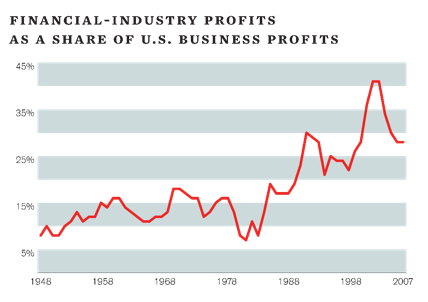
Matt Yglesias and Maxine Udall write about how talent, like capital, has been preferentially allocated to the financial sector in the last two decades during which the financial industry has grown from about 20% to above 40% in its share of corporate profits. It dropped sharply as Wall Street bled money in 2008 but if recent earnings results are any indication, they are headed back up there quickly.

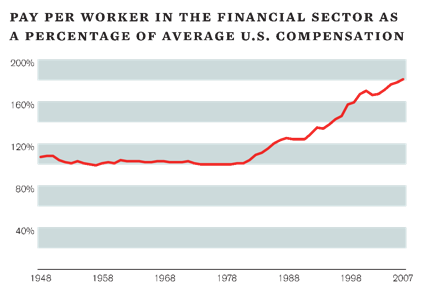
The financial sector’s average pay has steadily increased where it is now close to 200% of the national average. This of course doesn’t sound too big because it also includes consumer finance and banking, not just wholesale capital markets.

More

A Better Year

This year has been a trying year for many of us. In the US and most of the West, unemployment is high and a gradual recovery is the best we can hope for. In the IT world, in India and elsewhere, things are much better at the end of the year but still a far cry from the hypergrowth that we’ve become used to.

For me personally, this has been a challenging year. I started out the year looking to switch gears and do something else after my four year stint at Gridstone. But a family health issue has become a priority that trumps everything else. This will require my wife’s and my full attention for a while. If there is one thing I hope the next year will bring is better health for my son.

In the meanwhile, I am working with startups and interesting companies, helping them to the extent I can. It keeps the juices flowing and hopefully I can add some value to their business.

This blog is now like an old friend to me. A constant companion, through good times and tough times. Always there for a couple of hours of enjoyable company. By extension, you, my readers are like old friends too. I feel like I know the regular commentors well even if I’ve never met you.

And the silent majority, the readers who read but never join the discussion, thank you for coming back again and again. Here’s a humble suggestion. If you do one thing in 2010, join the discussion. Not necessarily on this blog. On any blog. On issues and topics that matter to you. Be heard. And hear yourself. It will feel good. Like you are plugging in to this massive collective brain that is humanity online. Like exercising your vote. It can be empowering.

I hope all of you have a great 2010. Or just a better year, perhaps. Happiness is a choice. I hope you choose to be happy.

Cheers!

Investing, My Way

This year saw a sea change in the way I invest. Umm…let me take that back. This year I finally decided to put in place an investment methodology. Something that will hopefully form the basis for the way I invest long into the future. I put some thought into it and so in case it might be useful to others, here it is. Needless to say, this is what works for me. Your context may be completely different and what works for you might be completely different (do leave a comment if you think it adds to the discussion).

More

Evernote for Android

I recently moved to an Android phone. I also use Evernote extensively and so I was thrilled when they launched Evernote for Android.

Besides the fact that it makes it so much easier to access my notes when I am on the move, there is another unexpected benefit. When you take a photo using your phone, the process of getting it off the phone and on to your computer is an extra step that slows things down. Taking pictures using Evernote makes that pain go away. When you take a photo using Evernote, it is automatically synced to the Evernote cloud and from there to your computer.

Here’s the first photo I took using Evernote, “Wake Up Sid” style!

Indian Church in Fremont

Fremont has a very high percentage of immigrants among the city residents. Especially North Fremont, where I live has a sizable Indian crowd. Most, like us are immigrants. Because of which Indian food, groceries and Bollywood movies are all within a ten minute drive, which is nice. Recently an Indian Church has come up close to where I live. I have never seen one before.

The proportion of Indian Christians amongst immigrant Indians may be higher than in India but still should not be more than say 10%. And given that there will be plenty of options on churches to join in the US, I wonder what drives the need for an Indian church. Could it be that Syrian Catholics (or other Indian Christian communities) from India practice their faith differently enough to feel the need for a separate church? Or is it the need to share their common, distinctive culture which an American church does not fulfill?