Google and Free Speech

Google issued a statement alleging that agents acting on behalf of China had tried to hack into certain corporate networks, including Google’s and the Gmail accounts of Chinese dissidents. They also announced that they would no longer censor search results on their Chinese search engine, which is required by Chinese law.

This is pretty important in many ways. Google is willing to give up China as a market in support of free speech. Some commentators have said that they were getting thrashed by Baidu anyway and so there’s not much that they’re giving up. But that is wrong. China is going to be the biggest internet search market in the world in a few years. It is unquestionably important. To even be second in that market could be worth a lot. That Google, a public company, is willing to give that up to hold up a principle, is huge. I can’t immediately recall any sacrifice of this magnitude by a public company for a principle.

More

English Medium Education Can Lead to Poorer English

Giridhar Rao has a new essay out From Mother Tongue to Many Tongues which makes two interesting points

One that English medium education can lead to “poor educational outcomes”

“It is now well established that when a child begins learning in his or her first language that child is more likely to succeed academically and is better able to learn additional languages.”

I blogged about this in my post More English and More Non-English.

But the other interesting point made is that English medium education can lead to general “language impoverishment”. (L2 here is English and L1 is the mother tongue.)

Starting L2 as early as possible, and teaching as much of the curriculum as possible through the L2 does not result in effective or widespread L2 acquisition. At best, this results in “subtractive bilingualism”: an L2 acquired at the expense of L1. Most often, the result is simply language impoverishment; not being able to use either L1 or L2 adequately.

The essay cites many references. Please go read it if you can.

The second point, that an early start or transition to English medium education, can actually lead to communicating in all languages poorly, including English, is counter intuitive and some of you may disagree with it just based upon your own personal experience or the people you know. But I would argue that the readers of this blog likely had a privileged environment – exposure to English at home and with friends early on etc. – or may have been gifted enough to overcome the disadvantage. So you are not exactly a random sample of India’s population.

Across the cross section of India, I think English medium education works to disperse educational outcomes. For a small minority, it results in better English skills but no better general educational outcomes. This small minority, who have an “English friendly” environment, an English medium education poses no hurdle, or a very small one. But the rewards are linked to opportunities in the global marketplace for higher education and jobs, including the export oriented service industries in India.

For the large majority, however, according to the research, English medium education works differently and leads to poorer educational outcomes and poorer language skills. If this is the case, it must be a matter of great concern to education administrators.

Whether there is language impoverishment in India compared to other countries, is a tough question to answer. In the companies I have worked in, American employees in the same role have uniformly had better English skills than Indian employees. But language impoverishment would imply that the English skills of the American employees were better than the Mother Tongue skills of Indian employees, which I wouldn’t know. My guess is they are.
Why is the Financial Industry this Big?

A few months back I wrote about why I thought salaries on Wall Street (and the city of London etc.) were not the big issue. The big one is about the humongous size and growth of the financial industry.

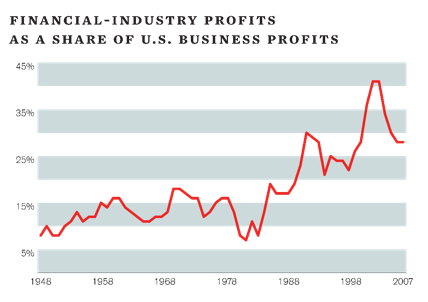
Matt Yglesias and Maxine Udall write about how talent, like capital, has been preferentially allocated to the financial sector in the last two decades during which the financial industry has grown from about 20% to above 40% in its share of corporate profits. It dropped sharply as Wall Street bled money in 2008 but if recent earnings results are any indication, they are headed back up there quickly.

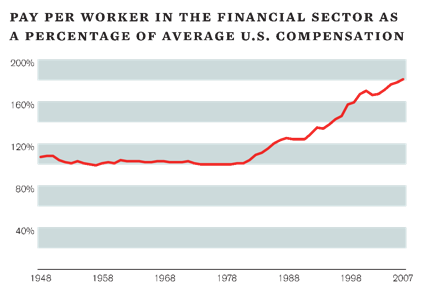
The financial sector’s average pay has steadily increased where it is now close to 200% of the national average. This of course doesn’t sound too big because it also includes consumer finance and banking, not just wholesale capital markets.

More

A Better Year

This year has been a trying year for many of us. In the US and most of the West, unemployment is high and a gradual recovery is the best we can hope for. In the IT world, in India and elsewhere, things are much better at the end of the year but still a far cry from the hypergrowth that we’ve become used to.

For me personally, this has been a challenging year. I started out the year looking to switch gears and do something else after my four year stint at Gridstone. But a family health issue has become a priority that trumps everything else. This will require my wife’s and my full attention for a while. If there is one thing I hope the next year will bring is better health for my son.

In the meanwhile, I am working with startups and interesting companies, helping them to the extent I can. It keeps the juices flowing and hopefully I can add some value to their business.

This blog is now like an old friend to me. A constant companion, through good times and tough times. Always there for a couple of hours of enjoyable company. By extension, you, my readers are like old friends too. I feel like I know the regular commentors well even if I’ve never met you.

And the silent majority, the readers who read but never join the discussion, thank you for coming back again and again. Here’s a humble suggestion. If you do one thing in 2010, join the discussion. Not necessarily on this blog. On any blog. On issues and topics that matter to you. Be heard. And hear yourself. It will feel good. Like you are plugging in to this massive collective brain that is humanity online. Like exercising your vote. It can be empowering.

I hope all of you have a great 2010. Or just a better year, perhaps. Happiness is a choice. I hope you choose to be happy.

Cheers!

Investing, My Way

This year saw a sea change in the way I invest. Umm…let me take that back. This year I finally decided to put in place an investment methodology. Something that will hopefully form the basis for the way I invest long into the future. I put some thought into it and so in case it might be useful to others, here it is. Needless to say, this is what works for me. Your context may be completely different and what works for you might be completely different (do leave a comment if you think it adds to the discussion).

More

Evernote for Android

I recently moved to an Android phone. I also use Evernote extensively and so I was thrilled when they launched Evernote for Android.

Besides the fact that it makes it so much easier to access my notes when I am on the move, there is another unexpected benefit. When you take a photo using your phone, the process of getting it off the phone and on to your computer is an extra step that slows things down. Taking pictures using Evernote makes that pain go away. When you take a photo using Evernote, it is automatically synced to the Evernote cloud and from there to your computer.

Here’s the first photo I took using Evernote, “Wake Up Sid” style!

Indian Church in Fremont

Fremont has a very high percentage of immigrants among the city residents. Especially North Fremont, where I live has a sizable Indian crowd. Most, like us are immigrants. Because of which Indian food, groceries and Bollywood movies are all within a ten minute drive, which is nice. Recently an Indian Church has come up close to where I live. I have never seen one before.

The proportion of Indian Christians amongst immigrant Indians may be higher than in India but still should not be more than say 10%. And given that there will be plenty of options on churches to join in the US, I wonder what drives the need for an Indian church. Could it be that Syrian Catholics (or other Indian Christian communities) from India practice their faith differently enough to feel the need for a separate church? Or is it the need to share their common, distinctive culture which an American church does not fulfill?

Make Work Homework

A few years ago my son who is now in middle school got some vocabulary homework for English. It was a pretty long list of words. He was supposed to write the meaning of each word and then use it in a sentence. And then, get this, draw or download a picture from the internet that illustrates the word. The homework took thrice as long as it would have without the illustrations.

Now if you think about it, if the child has learnt to use the word in a sentence, there is little value in an illustration. Especially, since most of the words pertained to intangible things like “blatant”. If it were an art class I can still see some value in an exercise where students reflect and then draw a picture depicting “blatant”. But not for 50 such words and not for an English class.

There is a phrase for this kind of work. Its called “Make Work”. Basically teachers are giving homework just to make up the 3 hours or whatever of homework they need to give per day. Like many issues, there is economics behind Make Work Homework.

Public schools and most private schools in the US have a student-teacher ratio that has gotten higher and higher over time. Obviously, there are cost reasons for this. The primary driver of cost efficiencies in a school is the average number of students in a class.

A teacher spends time on preparing for class, grading homework and other small activities. The time required for preparing for class does not vary by the number of students in class. It also goes down with experience. But grading homework varies directly with the number of students. And it can add up to quite a lot of work. If the teacher is hard pressed for time, she can’t reduce the amount of homework given to students. But she can give the kind of homework that takes less time to check. The example I cite above is exactly that kind of homework – with asymmetric workloads for student and teacher.

I believe this is the root cause of Make Work Homework. It takes a lot of time for the student to draw an illustration and very little to eyeball it while grading. This asymmetry works in favor of the teacher. She can give the prescribed amount of homework and still keep her grading workload low.

This is not to say that anything requiring an illustration is Make Work. Not at all. Sometimes it is absolutely necessary. Visual learning can be very powerful. And sometimes it can be justified with the argument that children learn in different ways and at different paces. What may seem like gratuitous drawing and coloring to one student may be essential reinforcement of what is being taught in class for another student.

But a lot of what passes as homework for our children, is the product of a teacher trying to reduce his workload.

Copenhagen – the Mother of all Negotiations

Who hasn’t been in a tough negotiation? If nothing else, negotiating with your kids can often be most difficult. But the negotiations at Copenhagen summit and next year on climate change are going to be the hairiest negotiations you can ever imagine.

An FT article [pay wall] shines some light on why the negotiations were so difficult. The biggest reason is of course that these are multi-lateral negotiations. And different groups have different interests. Developed countries want developing countries to make commitments on emission reductions while not over committing themselves. They also want transparency in developing country emission measurement.

Developing countries don’t want emission reductions to get in the way of development. They want developed countries to pay for clean technology.

There are a also a whole bunch of developing countries in Africa who are not significant emitters but will feel the brunt of climate change. They have nothing to give in the negotiations but a lot is at stake for them.

And then there are also a few heads of state like Chavez, Morales and Ahmadinejad, who simply use the stage to take potshots at the US and the West. But they still have to be invited to party.

Obviously, 170 independent actors can never achieve any consensus. So groups were formed. US, UK, Germany, France as representatives of the developed countries and China, India, Brazil and South Africa as representatives of the developing world. But this still wasn’t enough to get an agreement. The bulk of the world’s emission in the next 20 years is going to come out of the US and China. If only these two countries had sat down and thrashed it out, we would have had a deal.

The world is not going to be happy with their leaders if they don’t put their shoulders to the wheel and get a deal together soon in the new year.

Ideas from the New York Times

The NY Times Magazine’s latest issue is on “ideas”. The ideas are of mixed standards, probably because they were force fitted into an alphabetical list as much as possible (“hey, we don’t have any ideas for X Y Z. We can’t discriminate against the bottom three so can you go and find any old idea.”). But here are some that I thought were great. Go read the whole thing if you can.

Here goes (alphabetically, of course):

Drunken Ultimatums. Revenge trumps rationality. An experiment with drunks shows how.

Empty Beer Bottles Make Better Weapons. The fizz in the full ones causes them to break at lower impacts.

More