Incentive Compensation as a Risk Factor

footnoted.org has a post highlighting a Risk Factor from the 10Q of Anworth, a company that invests in agency backed mortgage securities. Here’s how it reads

In the risk factors section of its first quarter 10-Q filed Friday, Anworth gives this warning: “In an effort to earn greater amounts of incentive compensation under their Employment Agreement[s], as our executive officers evaluate different mortgage-related assets for our investment, there is a risk that they will cause us to assume more risk than is prudent.” (Anworth has included a version of this disclosure in its filings for the past couple of years, but the latest Q throws in some new language about the structure of a certain bonus pool.)

Now its all great that Anworth is making full disclosure on what it thinks are truly its risk factors. But really, calling compensation policy a risk factor is like saying “Our management practices are deficient. And now you’ve been warned.” This begs the question – why don’t they fix the incentive compensation?

On the other hand, one can rightfully ask, why aren’t other companies giving “uncontrollable executive greed” as a risk factor? Its not like everyone else but Anworth has found the answer. The problem is far too deep set. It is a difficult problem to solve. I have written about this before as well here and here.

One of the topmost problems that the Capital Markets will have to solve as it digs itself out of the hole it is in is executive compensation. Disclosing it as a risk factor isn’t enough.
Outsourcing Captives is Not an Acquisition

About a year ago, I had written about why offshore IT captives don’t work [link]. Now I hear that the companies that had set up captives in India are rushing to get rid of them. Except that there is a curious twist. They want to be paid to rid themselves of their mismanaged captives.

More

New Look for the Blog

As you will notice, 6AMP has a new look. The old theme worked well, but I was tiring of it. The new WordPress theme is called Statement and is from Blogoh!Blog that I was happy to learn is now run by Jai Nischal Verma of Delhi.

The theme is clean and functional but easy on the eye. Migrating to the new theme required some work, but no major challenges. Had to figure out how to edit a psd file without having to buy Photoshop. GIMP did the trick.

I think I have everything working. Let me know if you find anything broken.

Setting Targets or Expectation Setting

Indian Finance Minister P. Chidambaram in an interview about India’s slowing GDP growth, to the Wall Street Journal says,

“We must aim at 9%, as I will, and we must be happy if it’s between 8% and 9%.”

This begs the question “Is he setting a goal for GDP growth for the country or is he managing expectations?”

A goal, IMO, is something that is ‘actionable’, i.e. you and your team can take actions which help you achieve that goal. Much like a goal in football, you can’t score one by just being on the field.

More

Haryana and Orissa lead Investment Tables

Ila Patnaik reviews CMIE data on state wise per capita investment in 2007. The states with the leading investment per capital are Haryana and Orissa. It just happens that I am quite familiar with both states since I am Oriya and go back there to visit my folks quite often and because I grew up in Haryana and go back there once in a while as well.

Both states have able forward thinking administrations. And some help of course. Haryana’s proximity to Delhi is something they have taken advantage of. Orissa is blessed with more than its fair share of natural resources. But beyond that there is still a lot of good work going on. In Bhubaneswar, the traffic isn’t anywhere near being a problem yet. But the government is working hard to widen roads. Shows that someone is thinking ahead.

Patnaik attributes the differences and the trends in investment per capita to the quality of the state government administration. If I were to drill down a little more and ask myself the question, what would I look at if I were to set up a new center for my business my criteria would be as follows:

More

The IP imperative for IT Services or How to Beat the Recession

The Indian IT Services industry is going to feel the pain of the US recession which is likely to spread to other major markets as well. This recession is going to be different as I have said before.

What do you do, when you are faced with a near certain slow down? You can try and squeeze whatever juice you can out of your as-is business, but that will take you only so far. Or you can choose to breathe some new life into your value prop and perhaps change the trajectory of your company.

More

Is Everyone a Day Trader

[Cross-posted on the Gridstone Blog].

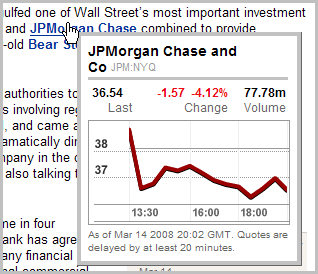
Ft.com has a nice widget that is very recent by my reckoning. If you hover over the name of a public company in any article on ft.com, a nice “chartlet” pops up. If you click on the company it takes you to the company in the Company Research part of their website.

I thought the pop-up was quite cool. It performs well, looks nice. It could even have been useful to readers. If I have one problem with it, it is the choice of the chart – a daily price chart.

More

Risk and Investment Banking Compensation

The erstwhile bosses at financial majors Citigroup, Merrill Lynch and Countrywide, were in Washington at Congressional hearings, defending their erstwhile pay packages. The New York times reports it here.

I have written before about the challenges in setting CEO compensation before [link]. In the capital markets it gets even more complex.

More