
The California Academy of Sciences in San Francisco has unmatched green credentials. A roof top garden called Living Roof, insulates the building. The solar canopy has 60,000 photo voltaic cells. The insulation in the walls is recycled denim. The disposable plates and forks in the cafeteria are compostable. All waste bins come in threes. The one that is generally called ‘trash’ carries a powerful message in its label. Brilliant.
Why do so many NBA games go to Overtime
There is a fascinating analysis of NBA scores by Jeff Ely and Toomas Hinnosaar on Ely’s blog Cheap Talk. Read through the comments as well which try to explain the data.
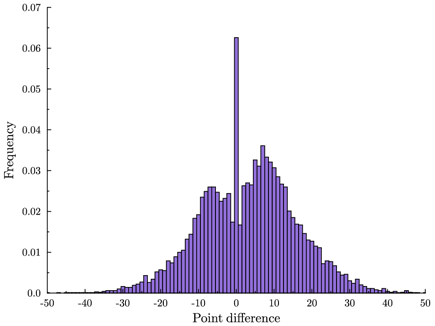
The data plotted in the chart is the margin of victory for the home team at the end of regulation (negative if they lose). There is a very pronounced spike at zero, implying that the % of games that are tied and go to OT is much higher than if it was closer to a normal distribution around a mean of zero.
There is a great video if you click through to the post, which shows how the distribution of the lead of the home team changes in the last 40 seconds of the game. Things look pretty normal till about 20 seconds are left. Something happens in the last 20 seconds that makes things converge to a tie.
The comments from readers try to explain this. The explanations that ring true to me are:
1. Shot selection – If the trailing team is within 3, it will attempt a 3 point shot. If it is within 2, it will typically go for a higher percentage shot for 2 points.
2. Fouling to stop the clock – The trailing team will keep fouling to stop the clock in the last 20s which will typically expand the lead. If they luck out and pull even, they stop fouling. If they pull ahead, the other team starts fouling.
Said differently, if the two teams are separated by 3 or fewer points in the final 20s and the trailing team has the ball, they will try to run out the clock and make a final shot attempt to tie the game (or win it if they are trailing by 1). If the leading team has the ball, the other team will foul them in the hope that they will miss a free shot and they get possession of the ball.
Ely offers his explanation here. Another thread of discussion on this is on Yglesias.
Conflicts of Interest in Healthcare
Atul Gawande’s piece The Cost Conundrum in the New Yorker has created quite a buzz. Apparently, President Obama has been recommending it as a must-read. Peter Orzag, the Director of the Office of Management and Budget for the administration, referred to Gawande’s article a couple of times in the last week.
The reason Gawande’s seminal piece has caught the attention of the blogosphere and the administration is because it uses data to point the finger where so far in the healthcare debate, it hasn’t – at doctors themselves. It’s easy to blame the insurance companies or the pharmaceutical companies. They are big, powerful corporations and it is natural to assume that must be twisting the system to their advantage thus raising costs for everyone. Doctors, whom we trust with our care, are much more difficult to confront. But confront them we must. It appears that the root of the problem in American healthcare is over-care.
Doctors are paid by insurance companies (or patients) by the amount of work they do (number of visits) not by the results. Insurance companies pay a standard rate per visit. They make no distinction between the rates they pay to a doctor that provides great care and one that provides poor care. The doctor therefore has all the incentive to increase the number visits and none to increase the quality of care (above a certain minimum, obviously, otherwise they won’t be left with any patients).
Spelling Bee Notes
Kavya Shivashankar won the 2009 Scripps Spelling Bee Championship, as has been widely reported. I watched the last few rounds of the contest. The Bee doesn’t sound like an exciting sport to watch, but once you get into it, it can be quite riveting.
The only word that I knew how to spell in those last few rounds was ‘menhir’. Amazingly, it tripped up Aishwarya Pastapur, who tied for second place. Why did I know how to spell menhir? Because of Asterix – that amazing comic book series that is unfortunately not widely available in the US.
Three years ago, I blogged about the unusual success that Indian kids were having in Spelling Bee. The post was titled Indian-Americans and the Spelling Bee Conundrum. Only 1.8% of the college educated US population is Indian-American. But as many as 20% of the top ten finalists from 2001 to 2005 were Indian-American. Obviously, this is way outside the bounds of random variation.
Well, that percentage this year was more than 50%. 6 out the 11 finalists (Scripps list) were Indian-American. There is an interesting interview on NPR of Balu Natarajan, the first Indian-American winner in 1985. He credits this success to the North-South Foundation a non-profit that promotes education in India. NSF organizes a Spelling Bee every year in the US which effectively is the breeding ground for the National Spelling Bee winners. Kavya won the junior NSF Bee in 2004. Incidentally, Balu Natarajan, in 1985 won on ‘milieu’, which would be a softball for today’s contestants.
It is ironic that Indians, whose mother tongues all spell words the way they are pronounced, should excel at Spelling Bee which exists because of the illogical, wayward spellings in the English language.
Google Voice – Different and Useful
 I have been a user of the Grand Central service for a long time, but I didn’t switch over completely until Google relaunched the service as Google Voice. Google acquired Grand Central a couple of years back after which there was nothing but silence for a while. When they relaunched in March, the new service had a couple of nifty features, but what tipped it over for me was that the relaunch indicated that Google was firmly committed to the future of Google Voice. After all, you don’t want to go handing out a new phone number to people and then have to change it again if the service was discontinued.
Google Voice is a pretty unique service. It is like having your own personal PBX system for free. You get a phone number when you sign up for the service. Calls to this number can be routed to a different number (home, mobile, work etc.) or sent straight to voice mail based upon time of day, caller ID or rules that you set up.
The Water in a Bottle of Water
 Got back from some vacation in the Mayan Riviera (near Cancun, Mexico). Had a lovely time. The structure in the background of the bottle is the amazing step pyramid at Chichen Itza.
In Mexico I encountered a familiar problem with bottled water that I face in India all the time – when you try to open a new bottle, you invariably spill some water. [Update: My experience in India is with Bisleri bottles primarily. A reader points out in the comments that there are other brands that don’t have this problem.]
There are two reasons for why this happens. One, the plastic wall of the bottle is thin. To unscrew the top, you need to grip the bottle hard, which squishes the bottle. When the top unscrews, the bottle is still a squished and the water gushes over. The second reason is that water in the bottle is filled right up to the top which gives no leeway at all when the bottle is squished.
In India and other emerging countries, keeping the costs is not so much about making a higher margin. It is about keeping the prices down so that you can capture a larger market. The food grade plastic used in the bottles is probably the largest variable cost for the bottler. It is no wonder he tries to minimize the amount of plastic per bottle.
That explains the thin plastic walls. And my guess is that it also explains why the water is filled all the way up to the top. The volume of water must be what it says on the bottle – 500 ml. or 1l. By filling the water all the way to the top the bottler can make the bottle just a wee bit smaller and save on the plastic.
The irony is that on account of these cost cutting measures, assuming that everyone spills a little water when opening the bottle for the first time, the consumer net, net, gets less water per rupee and the nuisance of cleaning up the spillage. On the other hand, it spares the earth – the plastics are petroleum products and aren’t biodegradable. Things are never black and white.
Rants From Delhi Airport
I’m in a bad mood. I am at Delhi International Airport waiting for my flight back to the US. The flight leaves at the ungodly hour of 330 am and is already 15 mins late. I go through security and learn that the lounge is before, not after security. Since I have three hours to kill (I spared my brother who dropped me off from waking up in the middle of the night) I go through the process of cancelling my security check stamps. And of course, the mandatory entry in a register with the police. I then try making my way back to the lounge but going back through security is not easy. The process wasn’t designed to handle it. I was stopped twice within ten feet by men in khaki who wanted to know why I was going the wrong way. Finally I get to the lounge. Luckily, there’s wifi so I can rant.
Best Practices in Voter Bribery
 India’s general elections are around the corner. As you know, the most important factor that determines the outcome of our elections is money – how much and how it is spent – in the crucial electoral process of buying votes.
The amount of money spent is, of course, a key determinant of electoral victory. We will cover that in a later article on Corruption and Campaign Finance. In this article we will discuss the state of the art in actually getting the bribes into the hands of the voters.
More on IT Unpolicy
In my previous post IT and the Role of Government I objected to Atanu Dey’s arguments against having an IT policy for India. He proposed, what I called an “IT Unpolicy” – basically, do nothing.
IT and the Government
Atanu Dey has a series of posts that criticize the IT Vision Document released by the BJP in the runup to the Indian elections. In his latest post The Rational IT Policy, he proposes an IT policy that basically does nothing – an Unpolicy, if you will. It requires government to stay out of the way of individuals and the market which will make their own decisions about using IT or not.
To me this seems wrong-headed. I think it is important for any government that comes to power to nurture and encourage the use of IT in government, business, education and at home.
 6 am pacific