For Budding Social Entrepreneurs

Many friends and people I know have been taking up responsibilities or causes that have a social objective. Education is a particularly good field where the needs are great in India and where people like us have been beneficiaries of a good education and all that comes with it.

Friend and former colleagues P R Ganapathy and Sandeep Shroff are both involved with non-profits. Guns, who is going back to India will spend part of his time with Teach for India. Sandeep has been involved with the Indian Literacy Project here in the Bay Area for many years. I do my little bit through my father’s trust Digjyoti Trust that supports higher education for orphaned and disadvantaged children.

Aside from the non-profit route, others are succeeding with a commercial model, but with a social objective embedded within it. Samhita Academy is one such educational institution. Their flagship school in Bangalore is doing quite well even though it is in just its third year.

The school is backed by the family of S. D. Shibulal, a friend, former colleague and founder of Infosys. Asha Thomas, Exec Director and her team have done a fantastic job in laying a solid foundation of the school. The infrastructure, staff, teaching methods – everything points to an excellent school in the making.

25% of the student population of Samhita Academy comprises of disadvantaged children whose costs are borne by the school. As Samhita Academy sets up more schools this objective will carry into the other schools as well. However, and this is the interesting thing, Samhita Academy is a commercially run enterprise. The fees must cover all costs. Why? because Shibu believes that this is a better model. If the schools are run like a commercial enterprise, the model becomes much more scalable. Ultimately, the social objective too is served better if the schools succeed commercially and expand to many more cities.

Samhita wants to now expand with more schools in other cities. They are looking for a leadership team. If you or anyone you know has climbed all the mountains you wanted to in your corporate job, and wanted to do something different and more meaningful, please contact Samhita. Or drop me a note and I’ll pass it on.

You Are the Technology Choices You Make

I finally dumped my HTC Hero on Sprint. I just couldn’t take it anymore – missing calls and the “click lag” on the HTC Hero. In the bargain, I learnt a few things:

Tech reviewers are biased. If they were truly honest in their reviews they would end up trashing the odd deserving candidate. Which would cut off their access to deliberately leaked official rumours and pre-release device units. So their praise is fulsome and the tear downs are gentle to non-existent. The HTC Hero was praised to high heavens. And I got taken in.

The best way to decide on buying a new product is to trial the product or ask a friend who has similar proclivities when it comes to personal technology. Someone I know, strongly recommended the T-mobile G1 to me just about when I was in the market for a new phone – I should have at least given it a try. But no, I had to reach out for the new, shiny object.

I like physical keyboards. I used a blackberry for ever, before I got the touch screen only HTC Hero. It’s possible that a touch screen that performs better, like the iPhone’s, might have been a better experience, but I doubt that I would prefer it to something with a physical keyboard. I can touch type on a computer keyboard. I don’t know if that contributes to it, or its the way I am, but I just can’t stand typing on a touch screen. After just two days with the G1 I am already typing longer emails than I ever did with the Hero.

I like Google’s sense of design. The G1 is not a very good looking phone compared to the eyecandy you see out there nowadays. But it has everything I need, and very little that I don’t. For Google, functionality and performance trumps every thing else. But when it doesn’t get in the way, they do pay attention to the aesthetics. Which is very different from the idea of HTC Sense, which sits on top of Android and now T-mobile itself is adding on an additional layer. Blah! who needs all that crud.

I consider myself to be an early adopter of technology. Not bleeding edge, but definitely by the time version 2 rolls around (yes, that would still make me an early adopter, maybe not compared to you dear reader, but compared to the rest of humanity that includes my Dad).

Early adoption of technology involves two big sacrifices – switching costs of learning something new and the risk that all the pieces may not be working as well as they should. For me learning something new is not an investment – it is learning and even entertainment – a plus rather than a minus. But I would rather wait than take the frustration of something that has rickety performance. For a less important app, like say a utility for taking screen shots, its OK to have a few features missing. But if its your cell phone you don’t want to mess with it (although, I did). I expect, in this regard, I am not very different from a lot of folks who read this blog.

Like everyone else, I like a good deal. So I bought my G1 on eBay and got a no contract deal with T-mobile. Soon the Pradhan family will be moving over to T-mobile as well and we will save something like $100 a month.

The only problem – T-mobile wouldn’t give me a post-paid contract – it seems my credit isn’t good enough. Which left me scratching my head because there is no problem with my credit (I checked). I concluded that this must be because we don’t carry any debt, so we don’t have enough credit history. It is a sign of the times that you need to be indebted first to get more debt.

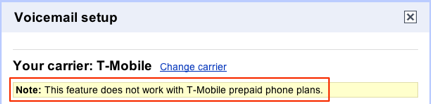
Which wouldn’t make any difference, except that for some reason Google Voice voice mail integration does not work with pre-paid T-mobile. Oh well, nothing’s perfect!

An Update

Some readers have asked for an update on the book. So I’ll start with that first.

Gaurav and I started out thinking of the book as a “How To” book on Offshore Services. But as we started writing it, it was turning out to be like writing a technical book – dry, precise and meant for the practitioner. In short, not a whole lot of fun.

I spoke to a well-known writer whose own book went through a little bit of a metamorphosis as well. Her advice was to write the book that you want to and will love to.

So we switched tracks and started thinking about a book that would be useful, widely read but also fun to write. A book about the Offshore industry that would go into all the issues and challenges facing it today and in the future. But it would be simply written so that even readers outside the industry could appreciate it.

That’s the book idea we took to Penguin. They liked it and they will publish the book in India in 2011. We plan to simultaneously self-publish with Amazon for markets outside the sub-continent.

On the personal front things have made a big U turn with my son Naren, who I wrote about a few months ago. In April the school district allowed him to attend regular school, but a different school. Yesterday was his last day at Hopkins Jr. High. We were confident that Naren would do well, but he exceeded all expectations. Not a single behavioural incident and every teacher had good things to say about him. In a new school, in just a short period of time, he made friends. The boy was determined to do well and he succeeded with flying colors. He also got a 4.0 for the last term. He now feels very confident that he can overcome his challenges and succeed in life.

There was good news outside of school too. Naren was accepted into the music composition summer program of the SF Conservatory. It is a prestigious program that’s hard to get into. He is absolutely thrilled about it. He now has a channel on YouTube where his compositions for the piano are posted. He also writes frequently on his blog at narenpradhan.wordpress.com about video games, scripts for TV shows and environmental issues.

Our battle with the school district to get Naren the right placement and services has been long and hard. It is not over yet but the worst is behind us. My wife and I can now start thinking about a future where life catches some kind of a groove.

A couple of other updates. I am doing a conference along with BRICS Securities which is slated for August in Mumbai. The conference will look at the long-term trends and issues in the Offshore Services industry. We are in the process of confirming the panelists for the panel discussions. I’ll post an update as we cover more ground.

In college I was very active in dramatics. Since graduating, I have wanted to, but have never had the time to commit to doing a play. Well, an opportunity came my way recently and I grabbed it. Who knows if I’ll ever have the time again.

The play [link is now updated] is a Mahesh Dattani play called “30 Days in September”. We will be doing eight shows in San Francisco in July. If you live here, I hope you’ll come.

Tablets and Netbooks

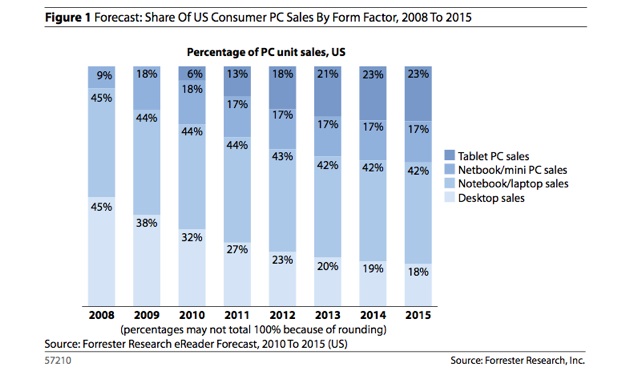
TechCrunch reports that Forrester Research has new research out that predicts that tablet computers will overtake netbook sales by 2012 and desktop computer sales by 2013. Only laptop computers will sell more than tablets.

At the height of the netbook fever I had commented on a post on Ajay Shah’s blog:

In reading his posts and yours, I wonder if we aren’t conflating two distinct properties of netbooks – small and cheap. From what we seek in India – deeper penetration of computers – “small” is no good, unless it in fact is the cause of “cheap”. A small keyboard and screen, in fact will prove to be a hindrance to adoption if this is going to be the first computer for people.

I never believed that netbooks were a different game-changing kind of computer. It was just a cheaper one. That tablets will overtake them is not a big stretch. But for tablets to become the largest selling personal computing device after laptops, that’s something.

I’ll confess, I don’t own an iPad. I’ve played around it at the nearby Best Buy. It has sex appeal, no doubt. But I find it difficult to imagine it as a serious computing device. Data input is always going to be challenging compared to a laptop. I just can’t see people buying an iPad as their only computer for personal use. It will probably have to be their second or third one.

It also can’t take the replacement market for computers at home for the same reason. So you’re looking at a market comprising of people who have enough disposable income for the tablet and the wireless data plan as a discretionary second or third computer for personal use. Essentially, it is a luxury good. I think its sales curve will also behave like that – quick uptake from early tech adopters but no hockey stick like the iPod or iPhone.

What this doesn’t factor in is the use of tablets in business. There is much in the air about tablet computers in healthcare. It does sound plausible that they will find a market in some industries. Another trend that could be favourable for it, but one that I am not seeing so far, is if people use a tablet with a docked station as their primary computer. I use a docked laptop at home but most people find it too cumbersome. I don’t think that will be a significant factor.

All that said, my hunches are shaped by my experiences. Unlike a lot of people, I find it painful to type on a screen. After years of using a blackberry, I tried out the HTC Hero. My experience has been so poor that I am now moving to an old Android phone, the G1, that has a keyboard. So clearly, you have to take what I think about touch screen devices with a large pinch of salt.

The Problem With Being Unsure

Felix Salmon writes about Helen Thomas having to quit her job after she said some nasty stuff on camera

Thomas gave voice to an opinion which she then, almost immediately, retracted; no one, in the subsequent debate, defended the substance of her remarks. She was wrong; everybody, including Thomas, agrees on that point, and no real harm was done to anyone but Thomas when the video of her remarks surfaced.

But if you turn out to be wrong, even temporarily, even only once, on a hot-button issue, that’s enough for effective excommunication from polite society. That, to me, is chilling: I’d much rather live in a world where people should be able to change their minds and should be allowed to be wrong on occasion. For surely we are all wrong, much more often than we like to think.

He then points to something Tyler Cowen said on bloggingheads.tv

Take whatever your political beliefs happen to be. Obviously the view you hold you think is most likely to be true, but I think you should give that something like 60-40, whereas in reality most people will give it 95 to 5 or 99 to 1 in terms of probability that it is correct. Or if you ask people what is the chance this view of yours is wrong, very few people are willing to assign it any number at all. Or if you ask people who believe in God or are atheists, what’s the chance you’re wrong – I’ve asked atheists what’s the chance you’re wrong and they’ll say something like a trillion to one, and that to me is absurd, that even if you think all of the strongest arguments for atheism are correct, your estimate that atheism is in fact the correct point of view shouldn’t be that high, maybe you know 90-10 or 95 to 5, at most. So that maybe is my most absurd view. Most things are much more up for grabs than we like to say they are.

I took away different things from these. if there is anything worse than being wrong it is being doubtful. Is this cultural? Or is it just human?

Rationally, Helen Thomas quitting is sort of wrong. She has an opinion which may be reprehensible to many of us, but it is still an opinion. She did not commit a crime. She probably even has an argument for why she is morally correct in holding that opinion. In any case, she recanted. In spite of that, why is it that Helen Thomas has to quit but this racist state senator doesn’t have to?

Expressing an opinion makes you belong to a certain group who hold the same opinion. The strength of that group – in size and the power of its members – and that of the group that holds opposing views – often determines whether you are right or wrong. Which completely explains why in today’s America anti-semitism can get you punished instantly, but racist remarks can be a cold, calculated play for fringe votes.

Politics and big business drive culture, especially, what is acceptable for public figures and celebrities. Investors will punish a CEO for being wrong (Prudential CEO, Tidjane Thiam) or being in the wrong place at the wrong time and then saying the wrong thing (“I want my life back” – Tony Hayward, BP CEO). But if there is one thing worse than being wrong, it is to be unsure of your beliefs.

Tyler Cowen would like people to be rational and admit that their opinions could have a higher probability of being wrong. But do people really want their leaders to not believe that they are 100% correct?

Imagine if President Obama were selling HCR by saying that “I am 100% certain that this bill will pull millions of uninsured into a life of dignity but only 60% sure that it will reduce our spending on healthcare in the long-term.” Which is pretty much the odds the most optimistic economist might give you.

People don’t even like their leaders to change their opinions. We call it flip-flopping. We not only want our leaders to be certain, we want them to have been certain about the issue at hand, since they gained consciousness. It also helps if their parents had the same stand on said issue.

This is not a development that is recent. Replying to a criticism during the Great Depression of having changed his position on monetary policy, John Keynes was pressured enough to burst out:

When the facts change, I change my mind. What do you do, sir?

I believe that this is a universal phenomenon. Human beings desire strong leaders – fearless and without doubt. Leadership, therefore becomes typed with certitude which becomes a desirable trait even for non-leaders. Which is perhaps unfortunate. With a 70% probability, that is.

IT Services Companies Should Empower Middle Management

Last week was quite eventful in the “Workshop of the World”. Foxconn, a Chinese manufacturer for companies such as Apple, Dell and HP, gave a 20% ad hoc raise to its workers after as many as ten suicides which called into question the working conditions at its plants. Fox Conn employs 800,000 workers in 20 plants across China.

Then it was Honda’s turn. Workers in Honda’s four factories in China struck work bringing all production in China to a halt. Yesterday Honda gave a 24% raise to workers, who were still not happy.

The strike in of itself was quite surprising. From FT

The right to strike was excised from the Chinese constitution in 1982, and attempts by workers to organise outside the official All China Federation of Trade Unions are frowned on by Beijing.

Amenities at Chinese factories like Foxconn are actually considered to be good. From Guardian

Foxconn is proud of the fact that it provides a swimming pool and other facilities to its staff, as well as organising chess, calligraphy, mountain climbing and fishing.

At both companies pay is not great but is above the legal minimum wage. Many workers make much more by working overtime.

How is this, in any way connected with the Indian IT employees’ angst? They are both about employees having nowhere to go with their problems.

Even though their demands and managements’ responses have been focused on pay increases, Chinese employees taking on their managements, is not really about salaries. How can it be when most employees come from the hinterland where wages are poor, that is, when there are jobs available? It is because the workers feel powerless. They are lost in these huge organizations. Foxconn has 800,000 employees. Honda also employs a similar number across its four plants. The “official” trade union is not elected and is really part of the establishment – a proxy for management. The workers have nowhere to go with their problems.

Cut to the Indian IT Services industry. Most of the successful companies of today are very centralized in how they operate. Historically, this was necessary. To scale up they had to build an organization which ran efficient, repeatable processes. For that it was necessary to have strong central control. But the very thing that helped them scale engineering and business processes, made the middle management powerless and weakened the bonds between the company and employee. It failed at the most important aspect of scaling a company – in building a loyal, motivated workforce.

When a company is small, the founders or the members of the top management know everybody themselves or with one degree of separation. They infuse the whole company with their values. Employees form a relationship with the company based upon these shared values.

But as the company grows, one degree of separation becomes two, three, four and more. Pretty soon what top management gets to hear is what they hear from their direct reports. What they have to say is said to a select few or to the media. How do you continue to build trust with your employees? You can’t do it yourself. So you must have your middle managers become interlocutors for you.

The problem is that middle managers are so disenfranchised that they feel powerless. They are the ones who run the delivery teams, who make the company tick. But they don’t have the leeway to solve their own day-to-day problems. When they take their problems to their superiors they discover that they too are powerless. So they just keep punching the clock. If somebody in their team comes to them with a problem, they just say, “I can’t help it, that’s the way it is”. When the rank and file IT worker starts griping about the company, some of these managers stay silent. Others join the griping. Nobody defends the company. They can’t. They don’t believe in it themselves. That’s where the battle is being lost.

In the case of Chinese workers, establishing a union that is truly representative might actually be the solution. Empowering middle management is less effective. In manufacturing there is a “class divide” between managers and workers, often based upon education and qualifications. Very few workers will ever be promoted into management. So the “us vs them” feeling almost guarantees strife, especially if as in the case of Honda, the Japanese managers earn much, much higher salaries.

But in an IT Services company every engineer has the qualifications to become the CEO of the company. It should therefore be easier to bridge the divide. Also, regardless of the quantity of outpouring on the internet, it still does not represent widespread disaffection.

Winning back middle management is the first step in turning things around with employee relations. Stuffing their mouths with money just pushes out the day of reckoning.

Indians and Unpredictability

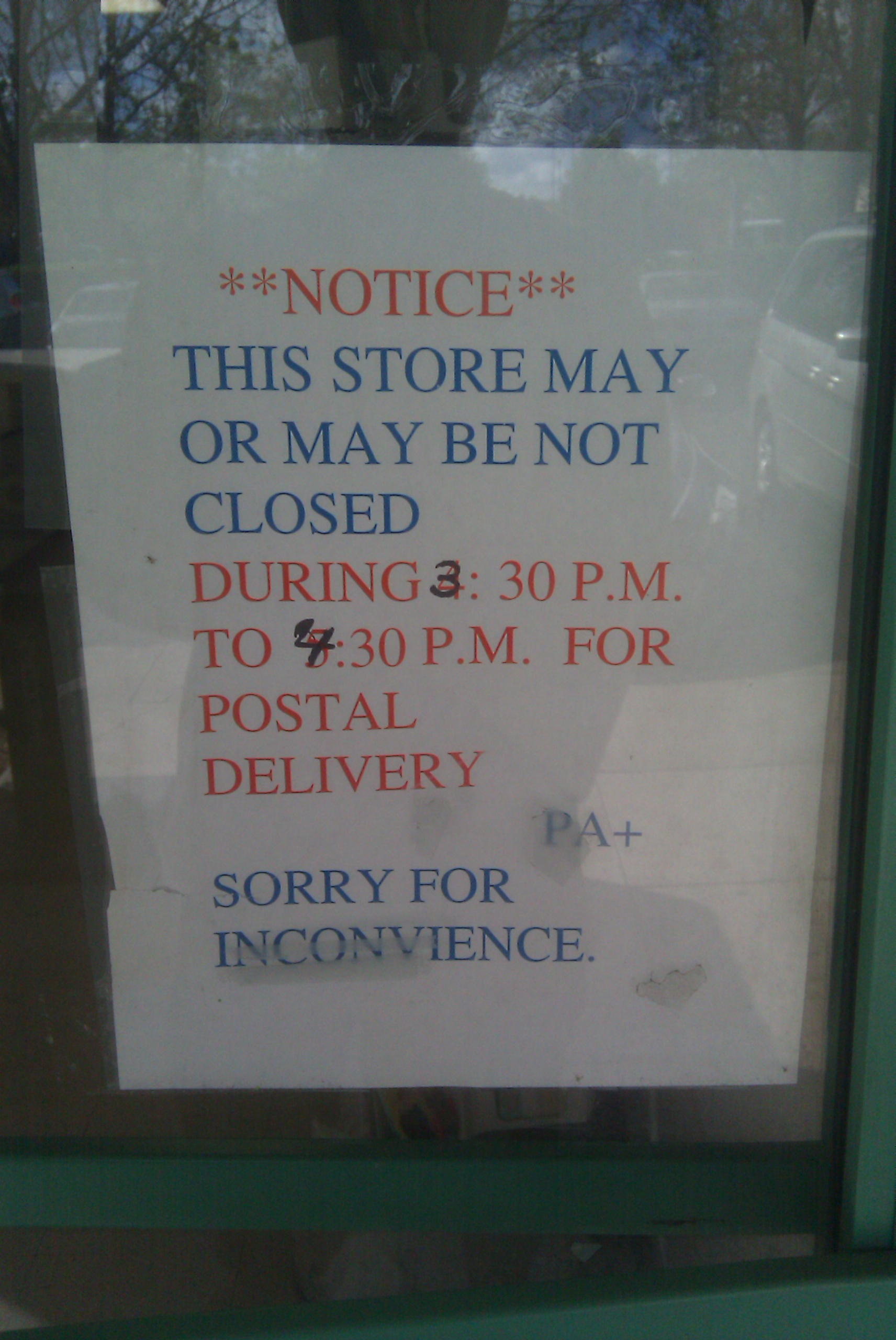
A notice at a neighbourhood Postal Annex. Truly, a picture is worth a thousand words. The proprietor is, you guessed it, Desi.

The notice is a microcosm of Indianness. If you get past the English (hey, its a foreign tongue, so stop being so fussy) it really is a reflection of our relationship with predictability.

There are three kinds of Indians:

– Those that are unpredictable and don’t care.
– Those that are unpredictable, but would like you to expect, and perhaps accept, their unpredictability. The store owner who put this notice up belongs to this set.
– The predictable kind. Within India, this is a very small set.

Indians are not brought up to be predictable in their behavior. The environment (Bangalore traffic for instance) doesn’t allow us to be. But this is certainly a phenotype issue not a genotype one. Because somehow, when Indians leave India they leave their unpredictability behind.

The great achievement of the IT Services industry has been to extract predictable outcomes for clients out of this morass of unpredictability. They erect these boundary walls around the company. Within these figurative walls there are no power cuts and meetings start on time. Defects are measured and deadlines are met. Because that’s what clients in the developed world expect. It’s gotten easier and easier over time, but in the early days the pioneers did the equivalent of moulding square pegs to fit into round holes.

Hinduism and Evolution


Today the Texas Board of Education voted on how American history will be taught in Texas schools. It is a version of history that fits the conservative world view. From the New York Times

The conservative members maintain that they are trying to correct what they see as a liberal bias among the teachers who proposed the curriculum. To that end, they made dozens of minor changes aimed at calling into question, among other things, concepts like the separation of church and state and the secular nature of the American Revolution.

Texas textbooks are important not just because Texas is a big state, but also because many small states just go with the Texas version of the textbooks because it costs less than commissioning their own versions.

Around this time last year the Texas Board voted to change science text books. Evolution, which is always in the spotlight when such matters are discussed, was saved by the skin of its teeth from being relegated to “one of many alternate theories”. However,

Failing to overhaul the curriculum broadly, conservatives instead attached a series of measures specific to subjects like biology, where teachers would be newly required to “analyze and evaluate the sufficiency or insufficiency of natural selection to explain the complexity of the cell.”

More

IPL on YouTube


From the FT today

Mr Walk said a recent Indian Premier League cricket series had notched up 55m views on YouTube – more in the US than in India – and it found a market for Bollywood in Estonia by offering Striker, a Bollywood film, either on a pay-per-stream basis or free with advertising support outside India.

I watched the IPL on Willow.tv for $60 for all matches. That sounds like a high hurdle for ad supported YouTube, but it isn’t. To pay $60 for Willow.tv is actually foolish. I paid $60 for the T20 World Cup and watched 15 minutes of cricket (the India-Australia match, if you must know). Granted IPL will be different because you won’t be that wedded to any team that you won’t watch the other matches. But even so, there is the matter of the quality of the video, which is consistent but average.

YouTube being free will attract an audience that could be 100 times larger. The asking average revenue from each viewer therefore is much, much lower. The opportunity for advertising is greatly underleveraged. There were banner ads around the video frame this time from some money transfer service but I’ll bet the inventory was sold super cheap, since those were the only ads I saw. But what about the interleaved ads between overs and during drinks? Why do folks in the US have to see an Indian cellphone ad? All this can add up to much more than what Willow.tv is taking in.

My guess is that IPL will be free next year on YouTube.

Markets Last Week

James Surowiecki sums up last week’s momentary free fall in the stock market:

But what does seem clear is that the plunge was exacerbated by the markets’ heavy reliance on computerized trades—both explicit “stop market” sell orders (that is, orders to sell a stock once it hit a certain price) and algorithmic trades that dictate buying and selling depending on different market factors.

and

I don’t think yesterday’s crash is evidence the market is irrational. It’s more that it’s a-rational: the computers aren’t panicking or herding. They’re just following simple rules. I think this is bad for the collective intelligence of the market, which really depends on diversity of thought and independence of action. But what happened yesterday isn’t, I think, quite the same as the crash of 1929 or the stock-market bubble of the late nineteen-nineties. It’s an example of the dangers of a-rationality (to coin a word) rather than irrationality.

Felix Salmon thinks this is an opportunity for a financial transaction tax

There’s a very sensible idea going around that a simple way to deal with nearly all of these problems, at a single stroke, would be to implement a tiny tax on financial transactions. Historically, people have complained that such a tax harms liquidity, which is true. But the fact is that it harms the bad kind of liquidity — the liquidity which dries up to zero just when you need it most. Liquidity, if it’s spread across multiple electronic exchanges and can disappear in a microsecond, does very little actual good, and in fact does harm during tail events like this. Let’s tax it, and raise some money for the public fisc at the same time as slowing down markets and making them think before doing a trade.

I think a financial transaction tax is a good idea. It is politically more doable at this time than any other time in the future. India already has one and it seems to do no harm to liquidity.

If you think about it, sales tax is a transaction tax. Why is it that there is no demur to a transaction tax on sales of goods (except on online commerce, which again is inexplicable), but financial transactions being taxed will bring about the end of capitalism?