Financial Transaction Tax

Philippe Douste-Blazy, the Chairman of Unitaid and the former French foreign minister writes in an op-ed in the New York Times about how the world could come up with the funds to meet the United Nations Millennium Development Goals

The one untapped source that could easily provide the amount of money needed is the foreign currency market, which handles almost $800 trillion in trades annually, all of which is untaxed. A tiny levy of 0.005 percent on transactions involving the world’s most traded currencies — the dollar, the euro, the pound and the yen — would raise more than $33 billion annually for development, while not hurting the market or affecting the average international traveler.

More

What’s So Difficult About a Gas Tax?

Tom Friedman in his latest column Real Men Tax Gas writes about a gas tax that could potentially fund healthcare, reduce the deficit and still have some leftover to make it up to people who can’t afford the tax:

Such a tax would make our economy healthier by reducing the deficit, by stimulating the renewable energy industry, by strengthening the dollar through shrinking oil imports and by helping to shift the burden of health care away from business to government so our companies can compete better globally. Such a tax would make our population healthier by expanding health care and reducing emissions. Such a tax would make our national-security healthier by shrinking our dependence on oil from countries that have drawn a bull’s-eye on our backs and by increasing our leverage over petro-dictators, like those in Iran, Russia and Venezuela, through shrinking their oil incomes.

More

Does Complexity Have Regressive Social Effects?

I have written about the virtues of simplicity in business before. But when I look around things are getting more and more complex.

Take the tax code for instance. The US tax code is so complex it is almost impossible to deal with for the average tax payer. An example of this is the Flexible Spending Account.

The FSA is supposed to give the tax payer a tax deduction on healthcare expenses that are not covered by their health insurance. It includes deductibles, co-pays and some kinds of health care expenses that are typically not covered by health insurance.

So far there’s not much you can object to. But the implementation is where it gets tricky. At the beginning of the year the employee must elect the amount to be deducted from their pay towards funding their FSA account. They can’t spend more than what is pre-funded in their accounts. If they spend less, they lose the money!

To me this seems hare-brained. If you are expenses go way over say because of some dental surgery expenses where the copays are high, you are out of luck if you didn’t foresee this at the beginning of the year. If your expenses are well under at the end of the year, you either lose the money or in the last month go hog wild buying OTC drugs that you don’t need. Who wants to see their own money go waste?!

More

Pay for Performance is Difficult to Implement

HealthcareIn the current debate on healthcare I’ve started hearing something that is quite familiar – pay for performance. The notion is simple – doctors should be paid based on patient outcomes not on the volume of work (fee-for-service). Its intent is easy to agree upon, but terribly difficult to implement.

In the Consulting and IT Services we have seen performance or outcome based pricing go through the entire hype cycle without getting any adoption to speak of. It’s not that customers didn’t want it enough or that vendors dragged their feet. It is just too hard to do. As a result, whenever I have seen pay for performance in contracts they have been in the form of bonuses that have never been big enough to impact vendor profitability seriously.

Pay for performance will be difficult to achieve in US healthcare as well. For reasons that are not very different from why they didn’t work in the IT industry. Here are the challenges:

More

Digital Book Economics

kindle_2_-_frontI got a Kindle recently and have so far enjoyed it. In almost every respect it beats the experience of reading the dead tree version. It is light and portable. I read non-fiction more than fiction and I hate lugging around the heavy hard cover. Turning pages (no paper cuts!) and bookmarking are both better. It seems to be perfectly designed to be read while working out on an elliptical. Font size control is a boon for those of us over 40. If you want a new book, buying it and downloading it wirelessly is dangerously simple and quick. I foresee bigger contributions to the Amazon.com empire from the Pradhan family.

There are a few disadvantages of course. The biggest one is the price. At $360 or so you don’t want to leave it on the airplane! You can’t loan a book to someone else. Books with illustrations won’t offer the same experience for a while (no DC comics on the Kindle so far). You are forever tied to amazon.com as your supplier of books. Much like the lock-in that music downloads from iTunes created for the iPod until Apple also moved to mp3 downloads. Funnily, the DRM that the publishers insist on creates a lock-in that benefits the device manufacturer the most.

Kindle, and hopefully other e-books, will change the economics of the book publishing industry. I can’t say if it will be for better or for worse for the publishers (probably worse) or authors (probably better). But the readers will certainly have more choice. And this can be very, very good for Amazon’s shareholders.

More

Funny Chart

Andrew Biggs compares spending on veterinary services and healthcare spending in the US. The case he makes is that the issue with healthcare is not the rate of growth of spending but the absolute amount of spending. He presents this chart as evidence of both. But it is a totally inappropriate way to represent the data.

The first thing that the chart hits you with is that the ‘slope’ of both lines is roughly the same. And the fact that Biggs’s conclusion is that the growth rate over the period is roughly the same for both might lead you to think that they are connected. But they aren’t. The lines are on different scales and so a comparison of slopes is meaningless. If you interpolate the data points, you get growth rates over the entire period of 267% for healthcare and 261% for vetcare. Close enough that the conclusions don’t change. But that’s not the point.

A chart of this kind (Y1/Y2) is the wrong choice to show similar growth rates. I could take any two time series and design the Y1, Y2 scales in such a way that they appear to be growing at the same rate. The right way of doing this would be an indexed chart such as is used to compare the performance of two stocks or a stock against an index.

indexed-chart

The Broader Context of Swatting Flies

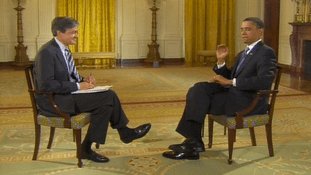
obama-could-hurt-a-fly-the-caucus-blog-nytimescomA couple of weeks back, President Obama swatted a fly in the White House. It did not go unnoticed in the media. Since this blog is about global trends, it would be remiss if I didn’t cover this important event and put it in the context of fly-swatting around the world.

The President is clearly a fit man with great reflexes. During the election campaign he sank a three pointer on demand for the camera which earned him my everlasting admiration. This time he swatted a fly that was bothering him during an interview in the White House. Nailing a fly is never easy, however, I am somewhat skeptical about the bona fides of the White House fly. Was it a house fly? If so, is it possible that the North American house fly is an entirely different species from the flies that I grew up with in India? They do look somewhat fat and happy over here, compared to the lean, mean third world variety. I don’t believe – and I say this from considerable experience – that a human being can swat one of those Indian flies with their hands. With a fly swatter, maybe, but not your bare hands. I mean no disrespect to the Prez, but that fly was not the real thing.

More

Evoking Negative Images can make for Effective Messaging

img_1329
The California Academy of Sciences in San Francisco has unmatched green credentials. A roof top garden called Living Roof, insulates the building. The solar canopy has 60,000 photo voltaic cells. The insulation in the walls is recycled denim. The disposable plates and forks in the cafeteria are compostable. All waste bins come in threes. The one that is generally called ‘trash’ carries a powerful message in its label. Brilliant.

Why do so many NBA games go to Overtime

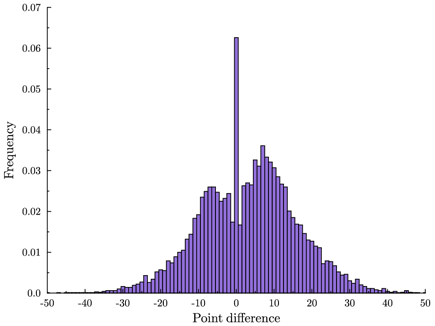
There is a fascinating analysis of NBA scores by Jeff Ely and Toomas Hinnosaar on Ely’s blog Cheap Talk. Read through the comments as well which try to explain the data.
histograminbantime

The data plotted in the chart is the margin of victory for the home team at the end of regulation (negative if they lose). There is a very pronounced spike at zero, implying that the % of games that are tied and go to OT is much higher than if it was closer to a normal distribution around a mean of zero.

There is a great video if you click through to the post, which shows how the distribution of the lead of the home team changes in the last 40 seconds of the game. Things look pretty normal till about 20 seconds are left. Something happens in the last 20 seconds that makes things converge to a tie.

The comments from readers try to explain this. The explanations that ring true to me are:

1. Shot selection – If the trailing team is within 3, it will attempt a 3 point shot. If it is within 2, it will typically go for a higher percentage shot for 2 points.
2. Fouling to stop the clock – The trailing team will keep fouling to stop the clock in the last 20s which will typically expand the lead. If they luck out and pull even, they stop fouling. If they pull ahead, the other team starts fouling.

Said differently, if the two teams are separated by 3 or fewer points in the final 20s and the trailing team has the ball, they will try to run out the clock and make a final shot attempt to tie the game (or win it if they are trailing by 1). If the leading team has the ball, the other team will foul them in the hope that they will miss a free shot and they get possession of the ball.

Ely offers his explanation here. Another thread of discussion on this is on Yglesias.
Conflicts of Interest in Healthcare

Atul Gawande’s piece The Cost Conundrum in the New Yorker has created quite a buzz. Apparently, President Obama has been recommending it as a must-read. Peter Orzag, the Director of the Office of Management and Budget for the administration, referred to Gawande’s article a couple of times in the last week.

The reason Gawande’s seminal piece has caught the attention of the blogosphere and the administration is because it uses data to point the finger where so far in the healthcare debate, it hasn’t – at doctors themselves. It’s easy to blame the insurance companies or the pharmaceutical companies. They are big, powerful corporations and it is natural to assume that must be twisting the system to their advantage thus raising costs for everyone. Doctors, whom we trust with our care, are much more difficult to confront. But confront them we must. It appears that the root of the problem in American healthcare is over-care.

Doctors are paid by insurance companies (or patients) by the amount of work they do (number of visits) not by the results. Insurance companies pay a standard rate per visit. They make no distinction between the rates they pay to a doctor that provides great care and one that provides poor care. The doctor therefore has all the incentive to increase the number visits and none to increase the quality of care (above a certain minimum, obviously, otherwise they won’t be left with any patients).

More