Money Begets Power Begets Money

Larry Lessig calls campaign fund-raising another form of corruption. It is interesting that in India if it were possible to get special interests to lawfully contribute to the campaign funds of politicians and not their own private accounts, we would probably declare victory against political corruption.

But, if you leave aside the fact that one is pernicious but lawful (the US) and the other is illegal and pernicious, there is little to choose between the two forms of corruption. The Indian version enriches the politician and his family. The primary use of that money is to fight elections (where the funds are used to buy mixer-grinders for the electorate, not TV ads). Money therefore becomes the means to stay in power.

In the US, it is the other way around. Campaign funds are used to fight elections. Once you win there are other legal ways to make money. Like through your spouses.

Ultimately, money and power are both means to ends and ends in of themselves. Whether special interests provide money to the politician or his campaign fund, they corrupt government and weaken democracy.

Corrupt Congress

Larry Lessig has an important article in The Nation about how campaign fund-raising has corrupted Congress.

This is corruption. Not the corruption of bribes, or of any other crime known to Title 18 of the US Code. Instead, it is a corruption of the faith Americans have in this core institution of our democracy. The vast majority of Americans believe money buys results in Congress (88 percent in a recent California poll). And whether that belief is true or not, the damage is the same. The democracy is feigned. A feigned democracy breeds cynicism. Cynicism leads to disengagement. Disengagement leaves the fox guarding the henhouse.

Read the whole article. You’ll hear a lot about this in the coming weeks (I fervently hope).

Here’s where you can sign the petition to Change Congress.

Sena Mobocracy

As the Shiv Sena stokes the fires of communalism, parochialism and other uglisms, Shahrukh Khan remains unfazed.

Siddharth Varadarajan writes

When confronted by the mob power of the Shiv Sena, MNS or other right-wing groups, the police in India invariably give in to their demands, no matter how irrational or unreasonable, and force the targets of their illegal pressure to give up their rights. So art galleries anywhere in India think once, twice and a hundred times before exhibiting a single painting by M.F. Hussain, movie hall owners agonise over whether to show ‘controversial’ films or not, screenplay writers and movie directors allow politicians, pundits, granthis and maulvis to vet their projects before they are launched, scholarly works of history are banned because their contents do not conform with the cherished hagiography of some group or sect, writers like Taslima Nasrin are hounded out of the country by mobs who claim to have been offended by books they have never read, shops fear to stock Valentine cards because of threats by self-appointed guardians of morality and ‘Indian culture’.

To me this is a law and order issue. Regardless of whether the protesters are right or wrong, if they go from protesting to rioting and arson, the police must act swiftly and decisively.

In India this is not as simple an issue as it might seem like. There are too many people, typically unemployed youth, who will gladly participate in a riot for the money. If the risk of being injured in a lathi charge goes up, all that will change is the asking rate for a rioter.

But letting the rioters destroy public and private property is just not an option. It subverts our freedoms and creates an alternate extra-governmental power center. Don’t feed the beast.

What to do About Falling Music Sales


David Goldman at CNNMoney.com writes about the decline in the music industry business

Apple’s (AAPL, Fortune 500) iTunes is credited with finally getting people to pay for digital music, but it wasn’t unveiled until 2003.

In the time between Napster’s shuttering and iTunes’ debut, many of Napster’s 60 million users found other online file sharing techniques to get music for free. Even after iTunes got people buying music tracks for just 99 cents, it wasn’t as attractive as free.

and

Now just 44% of U.S. Internet users and 64% of Americans who buy digital music think that that music is worth paying for, according to Forrester. The volume of unauthorized downloads continues to represent about 90% of the market, according to online download tracker BigChampagne Media Measurement.

Matt Yglesias responds

Music industry executives can tell themselves that as long as they want. But under conditions of perfect competition, the price of a song ought to be equal to the marginal cost of distributing a new copy of a song. Which is to say that the marginal cost ought to be $0. That’s not a question of habit, you can look it up in all the leading textbooks. Of course real businesses rarely operate in circumstances of perfect competition, and record companies have a variety of political and legal tools they can deploy to try to protect monopoly rents. But this is hard to do. I think the real story with the iTunes store is that over time competitive pressure has impelled it to largely drop DRM and over time I expect we’ll see that the CPI-adjusted price of songs declines.

If you are a music industry executive, you can wait for CD sales to bottom out at somewhere close to nothing. Or you can take the initiative

I don’t know if any research has been done on this or not. But it seems to me that $1 is just too high a price for a song. At that price, a high school or college student faces the choice of transferring music from his friend for free or paying $40 to get a few albums of a new band that he got interested in. There’s no contest.

You might say that by this logic you can never win against free. You can, if you make it really easy to access and download cheap music from legal sites. If iTunes had song downloads for 10 cents you would convert a large majority of “pirates” to legal downloads.

India’s Parliamentary Form of Government Rocks

Last week was a good week for President Obama. A State of the Union Address that was much more plain speak than his usual soaring rhetoric. Then he went into the lion’s den – the Republican Caucus – and demolished them on national television. Without a teleprompter, this time.

That said, the arithmetic in the Senate hasn’t changed. You still need 60 votes in the senate to prevent a filibuster and the Democrats don’t have them. So the stalemate continues.

The use of the filibuster has increased over time to where getting anything passed in a Senate with 100 seats requires 60 votes. Ezra Klein writes about how a supermajority of 60 votes is now a necessity for anything significant to pass in the Senate.

For someone who was educated in India (Civics used to be a separate subject in school) the filibuster and its evolution into a supermajority requirement in the Senate, seems odd. In fact there are many things about the system of government in the US that are odd and like the filibuster don’t really serve the purpose of furthering either democracy or good governance.

Start with the role of the President. There was a time in India when as impatient young people with ideas, my friends and I would look at the American Presidential form of government admiringly. Wouldn’t it be nice to have a Presidential form of government that elected a President directly and then he or she would be able to rule wisely and justly and do what was right instead of being beholden to the party apparatchiks or coalition partners?

Wrong. The American President is the head of the Executive, but any significant change involves legislation, which is what the US Congress does. And the US Congress can oppose or stymie the President, or just tie itself up in knots trying to pass legislation. When it does, it is full of compromises and earmarks. And the President, as you can see, can do almost nothing about it.

The Indian Parliamentary system actually is dead simple in comparison. The majority party or coalition in the Lok Sabha gets to rule. Their leader becomes the Prime Minister who is the head of the government. Bills from the government, may be opposed vehemently by the opposition, but they need only a majority to pass which the ruling party already has. If a bill is defeated on the floor of the Lok Sabha, a no-confidence vote might follow which could bring down the government. Something that happens only rarely.

The Rajya Sabha, the other house, is involved in law-making but doesn’t have any teeth. Neither does the President of India. In general, if you are elected into a majority, you can rule unhampered. Now that doesn’t mean there aren’t other challenges – coalition politics does weaken the government – but that is more related to the politics of the moment, where regional parties are much stronger than they have been in the past, than a structural issue with the functioning of the legislative process.

The American Congress is bicameral. Both houses are powerful and actively involved in shaping legislation. Districts that elect the House of Representatives are drawn based upon population, just like the Lok Sabha. But the Senate is a completely different animal. There are two senators per state. Wyoming with a population of half a million sends two senators to the senate and so does California with 37 million people. Because of this, the composition of the Senate is not really representative of the American people.

At the state level things can get even weirder. The symmetry in how democracy functions in India at the state and national levels is absent in the US. A state like California whose finances are in shambles is unable to do much about it because every important piece of legislation can be forced to a referendum. This law was inflicted upon California by Californians themselves. To change this law you need a 2/3rd majority in the Assembly. Till that time, you can’t raise taxes and you can’t take on the public employee unions. The result is deficits galore.

Matt Yglesias has another problem with American elections. It is with the number of officials that people need to elect.

Consider, for example, America’s staggering quantity of elected officials. If you live in Toronto, you vote for a member of the Toronto City Council, you vote for a member of the Ontario Parliament, and you vote for a member of the Canadian Parliament. That’s one large Anglophone city in North America.

What happens in New York City? Well, you’ve got a city council member, a borough president, a mayor, a public advocate, a comptroller, and a district attorney. You’ve also got a state assembly member, a state senator, an attorney-general, a state comptroller, and a governor. Then at the federal level, there’s a member of congress, two senators, and the president. That’s sixteen legislative and elected officials rather than Toronto’s three. New Yorkers don’t have three times as much time in their day to monitor the performance of elected officials. Instead, New Yorker elected officials simply aren’t monitored as closely.

So the next time you feel like we should seek a different form of government in India, count your blessings. It could have been much worse. We could have adopted the US form of government instead of British parliamentary democracy in 1950.

Photo by thecnote

Paper Problems

I have been dealing with a lot of paperwork lately. It’s amazing how paper centric things still are. Almost all dealings with the public agencies like the school and school district are on paper. There is some email but no formal communication – forms and stuff – is online. Teachers, by and large, avoid email so they won’t be pestered by parents (I can’t see any other reason).

Doctors and other service providers who bill on time, never use email. Understandably, since that breaks the $/hr model which personal visits and phone calls support. All forms, bills, health insurance claims – it is all paper, if the doctor doesn’t bill the insurance company directly.

Bill presentment is moving online, but most companies, including companies like Comcast, PG&E and local utilities do it poorly. Which leads to frustration online or you revert back to paper bills.

Anyway, there’s a lot of paper. I’m not very good with filing and such like. And the fax machine at home is temperamental. So I decided to up my Evernote subscription to paid and started scanning paper docs into it. That way I can tag it multiple ways, instead of filing it (single tag). Evernote also makes the pdf searchable so finding it when I need it will be easier.

Pretty soon I was doing a lot of scanning. I have a flat bed scanner. And with a flat bed scanner, scanning multi page docs is a huge pain. First, you have to go back and forth between the scanner and the computer for each page. After all that, I was getting as many pdf docs and there were pages.

To get a combined pdf, the easy solution was to install the HP software that came with the printer-scanner. But then that is a mammoth 300 MB installed and just on principle I wasn’t going to do that. I have not understood why HP thinks that just because they have sold me a printer they have the right to install all kinds of junk on my computer that I don’t need or want. And they make it so difficult to install just the piece that you want, including threats like “We would strongly advise you to install the entire software”. After installing, the software will force itself into the Mac quick launch tray and the menu up top, without so much as a by your leave.

So as you can see, I don’t like HP very much and I wasn’t going to install their monstrosity just for combining pdfs. Happily, there is this Mac automator script which achieves that very readily.

That leaves the problem of the scanner itself. Why are sheet feed scanners so expensive? I can’t believe that the cost of production is higher. It has to be that manufacturers believe that a sheet feed scanner is generally required by a business not by consumers and so it can take a higher price. Or because a specialized scanner has no annuity printer ink revenue. I can’t see any other reason.

My iPad Will Have to Wait

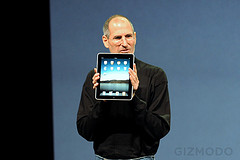
Apple iPadI am sitting here in a doctor’s office with time to kill and no broadband. I spent a half hour on Google Reader on my Android Phone and now I’m seeing things blurry from straining my eyes too long. Wouldn’t it have been great if I had the iPad with a 3G connection?

Not really. I had my MacBook with me, so what I really needed is a 3G connection not a third device. And 3G connections costs money which I can’t justify based upon the amount I would use it with my laptop (only occasionally). I already have a $100 bill for my cellphone out of which probably $40 can be attributed to the data connection.

For me, and I suspect for a lot of people, the iPad is going to come down to how they answer these questions:

– Of the three devices – smart phone, laptop and tablet – do I need all three or will two do? I can see some people saying I need to stay with my company’s Windows laptop but I’d really love to have something from Apple for browsing, entertainment and light work, which is most of what I do at home. iPad could be it for those people.

– But for most people just three devices will be too many. If two will do, what are those two devices? My guess is the iPad is not going to find a place in the top two, too often.

– How many 3G connections can I afford and which devices should have them?

On the second point, Apple can’t do much. It also doesn’t need to since it practically owns the smart phone category and has a growing MacBook franchise.

But the cost of 3G plans is a big hurdle for the iPad. And with its clout with mobile operators, it can do something about it.

I think that it’s safe to say that without a 3G connection, the iPad is much less useful. It then becomes more of a bulky iPod – a gaming and entertainment device that you can’t put in your pocket – than a constant companion that saves you from squinting at your smartphone screen while waiting in doctors’ offices.

But if every 3G connection is going to cost me $30 to $60 extra, I don’t think it works, at least for my MCIM (middle-class Indian mentality).

But it doesn’t have to be that way. Why can’t I get a 3G plan that is just variable – it bills me by the MB across all devices I use?

Now that’s a plan that would make it easier for me to go for the iPad. I’d probably still wait for the price to come down and the specs to go up, which will happen in a year for sure.

Update: But maybe the iPad is actually a Kindle replacement, except that it can turn many tricks that the Kindle can’t. Really? A backlit screen for reading books? Not for me, though. And someone who agrees with me.

Photo Matt Buchanan

Piracy Pulling Down Music Sales

The FT reports that 95% of digital music downloads are illegal. The RIAA has tried many things, including taking college kids to court. Nothing works.

To my mind, piracy of music:

1. Is inversely related to the chances of getting caught, which is very low.
2. Is inversely related to the punishment if caught, which is mild.
3. Is inversely related to the disapproval from friends and family who might know that you are using illegal music. This is almost non-existent.

All of these factors might indicate that piracy can’t be vanquished. But there is something that the music labels could do to start beating it back – reduce the cost of digital music dramatically.

Today the price of a song averages around $1. The marginal cost of delivering the next song is close to zero. So if you were to somehow know what the price to downloads curve might look like, all you would do is to set a price where the product of price and downloads was maximum. But of course, you don’t. Which is why the price of a song is stuck at $1.

I don’t know if any research has been done on this or not. But it seems to me that $1 is just too high a price for a song. At that price, a high school or college student faces the choice of transferring music from his friend for free or paying $40 to get a few albums of a new band that he got interested in. There’s no contest.

You might say that by this logic you can never win against free. You can, if you make it really easy to access and download cheap music from legal sites. If iTunes had song downloads for 10 cents you would convert a large majority of “pirates” to legal downloads.

Obviously, executives in the music industry have a pretty tough choice. First, they may not be able to convince all parties – Apple, artistes – to agree to a dramatically lower price. Doing it for one song doesn’t really work – it won’t change habits. They need to go the Full Monty. That’s a tough sell. Even if they managed to get that far, it is likely that revenue would plummet in the short term before it started rising again. On the other hand, it takes one bad quarter to get you fired.

The leap of faith is that reducing the price per song to a tenth of what it is today can take the share of legal downloads from 5% to 50%. Isn’t it time someone took that chance? After all, things can’t get much worse can they?

Wall Street’s Chickens Come Home to Roost

President Obama yesterday fired the first salvo in what is going to be a bruising battle to rein in Wall Street. More than a year after the financial crisis brought the economies of the developed world to its knees, its been business as usual, perhaps even a little better than usual, for the financial sector.

Well, no longer. The President in a hard hitting speech blamed Wall Street for financial crisis and the ongoing economic slump. He then laid out what he called the Volcker Rule, as a nod to Paul Volcker, former Fed chief, who has suddenly become very influential. While the details were scant, the thrust of the Volcker Rule was two-pronged.

More

Management Consulting in India

A new research paper Management Matters: Evidence from India suggests that the average Indian company can be improved significantly with the help of modern business practices. The study involved offering free consulting to a set of mid sized companies in the textile industry. The companies that availed of the free consulting showed a significant improvement in efficiency, lower inventories and higher profits, after they implemented the recommendations. The paper is long but is an interesting read. Also read Ajay Shah’s take on it.

The first thing to ponder is if Indian business practices are less modern. They may be technologically behind the best in the world and they might suffer on account of the creaky infrastructure that supports them. But is it also true that even in the context that they find themselves in, their business practices leave much to be desired?

The paper implies that this is indeed the case. I tend to agree with its conclusion. This is not to say that there aren’t well managed Indian firms – the research focused on mid-sized family owned businesses. But I think that it is safe to say that like technological innovation, management innovation is largely centered in the western world. A lot of it is applicable even to the Indian context, but it’s penetration is not too deep.

The authors then go on to say that the reason why Indian firms are not well managed is because management is not well informed about modern management techniques. They distrust outsiders and rarely use management consultants and so leave themselves in a low information cocoon. They don’t hire business school grads and there isn’t much mobility within the industry that could disseminate best practices.

One of the recommendations of the authors is that a robust management consulting industry could solve some of these problems. The research was supported and partly financed by a management consulting firm, Accenture. So this conclusion is somewhat self-serving, but not necessarily incorrect because of that.

After employee mobility in the industry, management consulting is perhaps the most successful way of disseminating new business practices. My sense is that Indian companies are not very open to management consulting in general. The cost is perceived to be very high. The change they bring about is thought to be too disruptive. And the improvement in the business, too chancy.

Maybe its management consultants who need to look at themselves to see if they are responsible for the underuse of their services in India.