Tablets and Netbooks

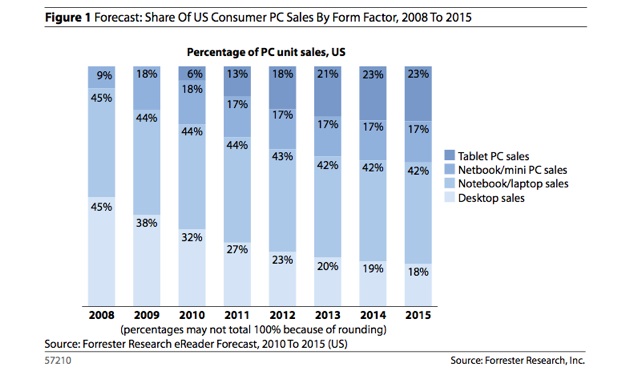
TechCrunch reports that Forrester Research has new research out that predicts that tablet computers will overtake netbook sales by 2012 and desktop computer sales by 2013. Only laptop computers will sell more than tablets.

At the height of the netbook fever I had commented on a post on Ajay Shah’s blog:

In reading his posts and yours, I wonder if we aren’t conflating two distinct properties of netbooks – small and cheap. From what we seek in India – deeper penetration of computers – “small” is no good, unless it in fact is the cause of “cheap”. A small keyboard and screen, in fact will prove to be a hindrance to adoption if this is going to be the first computer for people.

I never believed that netbooks were a different game-changing kind of computer. It was just a cheaper one. That tablets will overtake them is not a big stretch. But for tablets to become the largest selling personal computing device after laptops, that’s something.

I’ll confess, I don’t own an iPad. I’ve played around it at the nearby Best Buy. It has sex appeal, no doubt. But I find it difficult to imagine it as a serious computing device. Data input is always going to be challenging compared to a laptop. I just can’t see people buying an iPad as their only computer for personal use. It will probably have to be their second or third one.

It also can’t take the replacement market for computers at home for the same reason. So you’re looking at a market comprising of people who have enough disposable income for the tablet and the wireless data plan as a discretionary second or third computer for personal use. Essentially, it is a luxury good. I think its sales curve will also behave like that – quick uptake from early tech adopters but no hockey stick like the iPod or iPhone.

What this doesn’t factor in is the use of tablets in business. There is much in the air about tablet computers in healthcare. It does sound plausible that they will find a market in some industries. Another trend that could be favourable for it, but one that I am not seeing so far, is if people use a tablet with a docked station as their primary computer. I use a docked laptop at home but most people find it too cumbersome. I don’t think that will be a significant factor.

All that said, my hunches are shaped by my experiences. Unlike a lot of people, I find it painful to type on a screen. After years of using a blackberry, I tried out the HTC Hero. My experience has been so poor that I am now moving to an old Android phone, the G1, that has a keyboard. So clearly, you have to take what I think about touch screen devices with a large pinch of salt.

The Problem With Being Unsure

Felix Salmon writes about Helen Thomas having to quit her job after she said some nasty stuff on camera

Thomas gave voice to an opinion which she then, almost immediately, retracted; no one, in the subsequent debate, defended the substance of her remarks. She was wrong; everybody, including Thomas, agrees on that point, and no real harm was done to anyone but Thomas when the video of her remarks surfaced.

But if you turn out to be wrong, even temporarily, even only once, on a hot-button issue, that’s enough for effective excommunication from polite society. That, to me, is chilling: I’d much rather live in a world where people should be able to change their minds and should be allowed to be wrong on occasion. For surely we are all wrong, much more often than we like to think.

He then points to something Tyler Cowen said on bloggingheads.tv

Take whatever your political beliefs happen to be. Obviously the view you hold you think is most likely to be true, but I think you should give that something like 60-40, whereas in reality most people will give it 95 to 5 or 99 to 1 in terms of probability that it is correct. Or if you ask people what is the chance this view of yours is wrong, very few people are willing to assign it any number at all. Or if you ask people who believe in God or are atheists, what’s the chance you’re wrong – I’ve asked atheists what’s the chance you’re wrong and they’ll say something like a trillion to one, and that to me is absurd, that even if you think all of the strongest arguments for atheism are correct, your estimate that atheism is in fact the correct point of view shouldn’t be that high, maybe you know 90-10 or 95 to 5, at most. So that maybe is my most absurd view. Most things are much more up for grabs than we like to say they are.

I took away different things from these. if there is anything worse than being wrong it is being doubtful. Is this cultural? Or is it just human?

Rationally, Helen Thomas quitting is sort of wrong. She has an opinion which may be reprehensible to many of us, but it is still an opinion. She did not commit a crime. She probably even has an argument for why she is morally correct in holding that opinion. In any case, she recanted. In spite of that, why is it that Helen Thomas has to quit but this racist state senator doesn’t have to?

Expressing an opinion makes you belong to a certain group who hold the same opinion. The strength of that group – in size and the power of its members – and that of the group that holds opposing views – often determines whether you are right or wrong. Which completely explains why in today’s America anti-semitism can get you punished instantly, but racist remarks can be a cold, calculated play for fringe votes.

Politics and big business drive culture, especially, what is acceptable for public figures and celebrities. Investors will punish a CEO for being wrong (Prudential CEO, Tidjane Thiam) or being in the wrong place at the wrong time and then saying the wrong thing (“I want my life back” – Tony Hayward, BP CEO). But if there is one thing worse than being wrong, it is to be unsure of your beliefs.

Tyler Cowen would like people to be rational and admit that their opinions could have a higher probability of being wrong. But do people really want their leaders to not believe that they are 100% correct?

Imagine if President Obama were selling HCR by saying that “I am 100% certain that this bill will pull millions of uninsured into a life of dignity but only 60% sure that it will reduce our spending on healthcare in the long-term.” Which is pretty much the odds the most optimistic economist might give you.

People don’t even like their leaders to change their opinions. We call it flip-flopping. We not only want our leaders to be certain, we want them to have been certain about the issue at hand, since they gained consciousness. It also helps if their parents had the same stand on said issue.

This is not a development that is recent. Replying to a criticism during the Great Depression of having changed his position on monetary policy, John Keynes was pressured enough to burst out:

When the facts change, I change my mind. What do you do, sir?

I believe that this is a universal phenomenon. Human beings desire strong leaders – fearless and without doubt. Leadership, therefore becomes typed with certitude which becomes a desirable trait even for non-leaders. Which is perhaps unfortunate. With a 70% probability, that is.

IT Services Companies Should Empower Middle Management

Last week was quite eventful in the “Workshop of the World”. Foxconn, a Chinese manufacturer for companies such as Apple, Dell and HP, gave a 20% ad hoc raise to its workers after as many as ten suicides which called into question the working conditions at its plants. Fox Conn employs 800,000 workers in 20 plants across China.

Then it was Honda’s turn. Workers in Honda’s four factories in China struck work bringing all production in China to a halt. Yesterday Honda gave a 24% raise to workers, who were still not happy.

The strike in of itself was quite surprising. From FT

The right to strike was excised from the Chinese constitution in 1982, and attempts by workers to organise outside the official All China Federation of Trade Unions are frowned on by Beijing.

Amenities at Chinese factories like Foxconn are actually considered to be good. From Guardian

Foxconn is proud of the fact that it provides a swimming pool and other facilities to its staff, as well as organising chess, calligraphy, mountain climbing and fishing.

At both companies pay is not great but is above the legal minimum wage. Many workers make much more by working overtime.

How is this, in any way connected with the Indian IT employees’ angst? They are both about employees having nowhere to go with their problems.

Even though their demands and managements’ responses have been focused on pay increases, Chinese employees taking on their managements, is not really about salaries. How can it be when most employees come from the hinterland where wages are poor, that is, when there are jobs available? It is because the workers feel powerless. They are lost in these huge organizations. Foxconn has 800,000 employees. Honda also employs a similar number across its four plants. The “official” trade union is not elected and is really part of the establishment – a proxy for management. The workers have nowhere to go with their problems.

Cut to the Indian IT Services industry. Most of the successful companies of today are very centralized in how they operate. Historically, this was necessary. To scale up they had to build an organization which ran efficient, repeatable processes. For that it was necessary to have strong central control. But the very thing that helped them scale engineering and business processes, made the middle management powerless and weakened the bonds between the company and employee. It failed at the most important aspect of scaling a company – in building a loyal, motivated workforce.

When a company is small, the founders or the members of the top management know everybody themselves or with one degree of separation. They infuse the whole company with their values. Employees form a relationship with the company based upon these shared values.

But as the company grows, one degree of separation becomes two, three, four and more. Pretty soon what top management gets to hear is what they hear from their direct reports. What they have to say is said to a select few or to the media. How do you continue to build trust with your employees? You can’t do it yourself. So you must have your middle managers become interlocutors for you.

The problem is that middle managers are so disenfranchised that they feel powerless. They are the ones who run the delivery teams, who make the company tick. But they don’t have the leeway to solve their own day-to-day problems. When they take their problems to their superiors they discover that they too are powerless. So they just keep punching the clock. If somebody in their team comes to them with a problem, they just say, “I can’t help it, that’s the way it is”. When the rank and file IT worker starts griping about the company, some of these managers stay silent. Others join the griping. Nobody defends the company. They can’t. They don’t believe in it themselves. That’s where the battle is being lost.

In the case of Chinese workers, establishing a union that is truly representative might actually be the solution. Empowering middle management is less effective. In manufacturing there is a “class divide” between managers and workers, often based upon education and qualifications. Very few workers will ever be promoted into management. So the “us vs them” feeling almost guarantees strife, especially if as in the case of Honda, the Japanese managers earn much, much higher salaries.

But in an IT Services company every engineer has the qualifications to become the CEO of the company. It should therefore be easier to bridge the divide. Also, regardless of the quantity of outpouring on the internet, it still does not represent widespread disaffection.

Winning back middle management is the first step in turning things around with employee relations. Stuffing their mouths with money just pushes out the day of reckoning.

Indians and Unpredictability

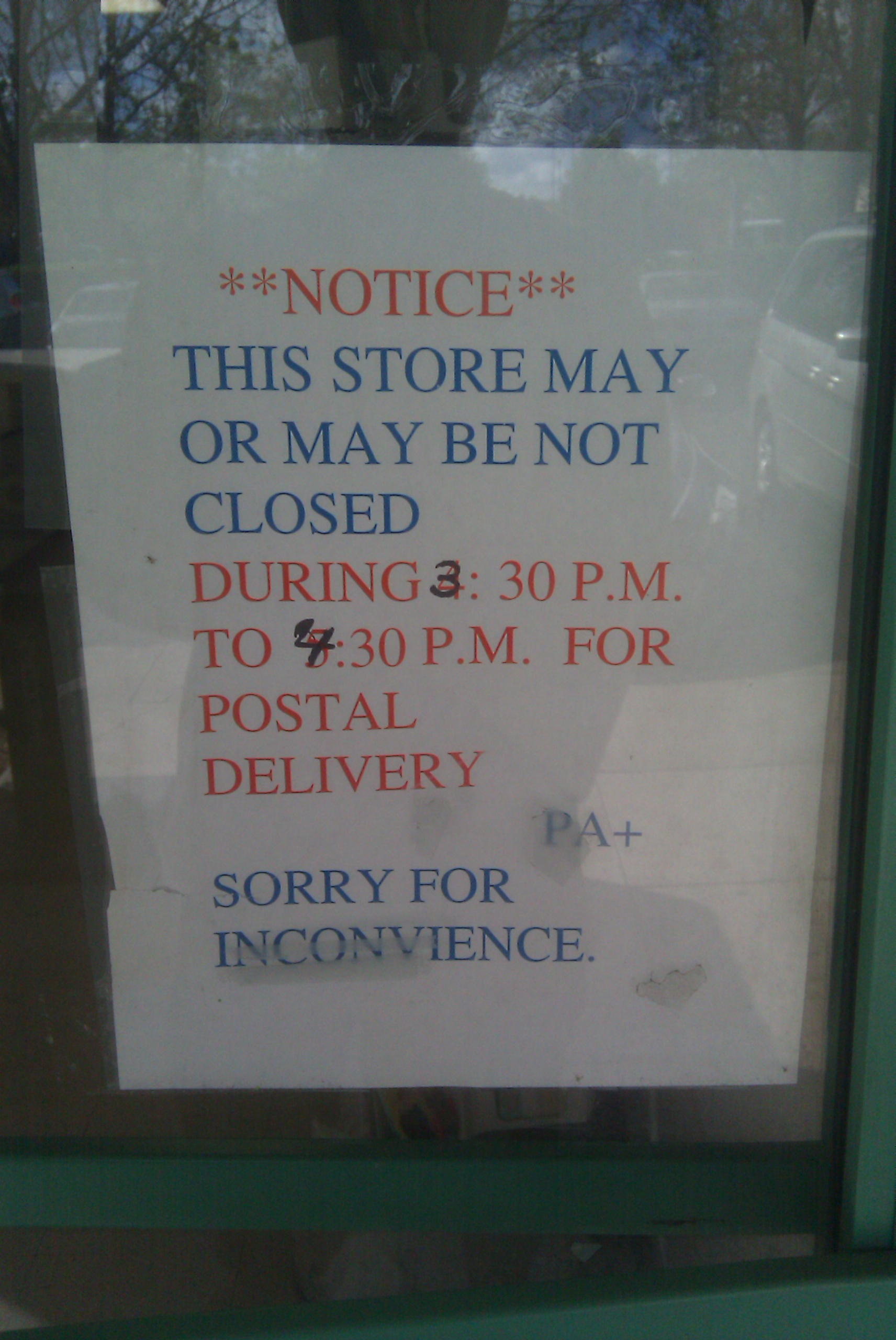
A notice at a neighbourhood Postal Annex. Truly, a picture is worth a thousand words. The proprietor is, you guessed it, Desi.

The notice is a microcosm of Indianness. If you get past the English (hey, its a foreign tongue, so stop being so fussy) it really is a reflection of our relationship with predictability.

There are three kinds of Indians:

– Those that are unpredictable and don’t care.
– Those that are unpredictable, but would like you to expect, and perhaps accept, their unpredictability. The store owner who put this notice up belongs to this set.
– The predictable kind. Within India, this is a very small set.

Indians are not brought up to be predictable in their behavior. The environment (Bangalore traffic for instance) doesn’t allow us to be. But this is certainly a phenotype issue not a genotype one. Because somehow, when Indians leave India they leave their unpredictability behind.

The great achievement of the IT Services industry has been to extract predictable outcomes for clients out of this morass of unpredictability. They erect these boundary walls around the company. Within these figurative walls there are no power cuts and meetings start on time. Defects are measured and deadlines are met. Because that’s what clients in the developed world expect. It’s gotten easier and easier over time, but in the early days the pioneers did the equivalent of moulding square pegs to fit into round holes.

Hinduism and Evolution


Today the Texas Board of Education voted on how American history will be taught in Texas schools. It is a version of history that fits the conservative world view. From the New York Times

The conservative members maintain that they are trying to correct what they see as a liberal bias among the teachers who proposed the curriculum. To that end, they made dozens of minor changes aimed at calling into question, among other things, concepts like the separation of church and state and the secular nature of the American Revolution.

Texas textbooks are important not just because Texas is a big state, but also because many small states just go with the Texas version of the textbooks because it costs less than commissioning their own versions.

Around this time last year the Texas Board voted to change science text books. Evolution, which is always in the spotlight when such matters are discussed, was saved by the skin of its teeth from being relegated to “one of many alternate theories”. However,

Failing to overhaul the curriculum broadly, conservatives instead attached a series of measures specific to subjects like biology, where teachers would be newly required to “analyze and evaluate the sufficiency or insufficiency of natural selection to explain the complexity of the cell.”

More

IPL on YouTube


From the FT today

Mr Walk said a recent Indian Premier League cricket series had notched up 55m views on YouTube – more in the US than in India – and it found a market for Bollywood in Estonia by offering Striker, a Bollywood film, either on a pay-per-stream basis or free with advertising support outside India.

I watched the IPL on Willow.tv for $60 for all matches. That sounds like a high hurdle for ad supported YouTube, but it isn’t. To pay $60 for Willow.tv is actually foolish. I paid $60 for the T20 World Cup and watched 15 minutes of cricket (the India-Australia match, if you must know). Granted IPL will be different because you won’t be that wedded to any team that you won’t watch the other matches. But even so, there is the matter of the quality of the video, which is consistent but average.

YouTube being free will attract an audience that could be 100 times larger. The asking average revenue from each viewer therefore is much, much lower. The opportunity for advertising is greatly underleveraged. There were banner ads around the video frame this time from some money transfer service but I’ll bet the inventory was sold super cheap, since those were the only ads I saw. But what about the interleaved ads between overs and during drinks? Why do folks in the US have to see an Indian cellphone ad? All this can add up to much more than what Willow.tv is taking in.

My guess is that IPL will be free next year on YouTube.

Markets Last Week

James Surowiecki sums up last week’s momentary free fall in the stock market:

But what does seem clear is that the plunge was exacerbated by the markets’ heavy reliance on computerized trades—both explicit “stop market” sell orders (that is, orders to sell a stock once it hit a certain price) and algorithmic trades that dictate buying and selling depending on different market factors.

and

I don’t think yesterday’s crash is evidence the market is irrational. It’s more that it’s a-rational: the computers aren’t panicking or herding. They’re just following simple rules. I think this is bad for the collective intelligence of the market, which really depends on diversity of thought and independence of action. But what happened yesterday isn’t, I think, quite the same as the crash of 1929 or the stock-market bubble of the late nineteen-nineties. It’s an example of the dangers of a-rationality (to coin a word) rather than irrationality.

Felix Salmon thinks this is an opportunity for a financial transaction tax

There’s a very sensible idea going around that a simple way to deal with nearly all of these problems, at a single stroke, would be to implement a tiny tax on financial transactions. Historically, people have complained that such a tax harms liquidity, which is true. But the fact is that it harms the bad kind of liquidity — the liquidity which dries up to zero just when you need it most. Liquidity, if it’s spread across multiple electronic exchanges and can disappear in a microsecond, does very little actual good, and in fact does harm during tail events like this. Let’s tax it, and raise some money for the public fisc at the same time as slowing down markets and making them think before doing a trade.

I think a financial transaction tax is a good idea. It is politically more doable at this time than any other time in the future. India already has one and it seems to do no harm to liquidity.

If you think about it, sales tax is a transaction tax. Why is it that there is no demur to a transaction tax on sales of goods (except on online commerce, which again is inexplicable), but financial transactions being taxed will bring about the end of capitalism?

IPL Notes

We watched the IPL T20 Finals yesterday. Some random musings:

  • We had subscribed to Willow.tv but YouTube quality was way better even though free. Willow.tv was $60 for the entire season. I wonder if advertising can pull in that kind of revenue per viewer. There was a lot of wastage, I thought. That dual SIM ad with Gambhir and Sehwag is now deeply etched on my brain for no useful purpose at all.
  • We were supporting Chennai but not really with any passion (I didn’t have a hoarse throat at the end of the game). We have supported an Indian team for so long that it is difficult to take sides when Dhoni and Tendulkar are on different teams. I wonder if this happens to other folks too. A friend from Bangalore was actually supporting the Chennai team just because they liked Dhoni. Another one, also, from Bangalore supports KKR for similar reasons. Is it because we so much identify with the Indian team or is it because we are all rootless, economic migrants who don’t identify with a particular city?
  • When Raina [corrected from Tendulkar] was dropped off Zaheer Khan, you could read his lips so clearly it should have been bleeped out.
  • The whole Shashi Tharoor matter has got me foxed. I cannot make head or tail of it. Some woman who had some connection with Tharoor got sweat equity in a company that was part of the consortium that won the bid for the Cochin IPL team. Now, I don’t watch Indian TV. Nor am I part of the grapevine on this kind of a thing. But from just reading online, I couldn’t make out why he had to leave. To leave he either had to have used his position as a minister to influence the selection process or there was some hanky panky going on between Tharoor and the woman which could not be denied. Or he chose not to deny it. If anyone can illuminate this clueless NRI with some links in the comments, it will be much appreciated.
  • The IPL has too much money involved for politicians to stay away from it. BCCI is already in their clutches. Cricket is too important to mess around with. How about if someone with unimpeachable credentials who also cared deeply about cricket became interim Chairman of IPL. Just long enough to put a new charter in place and hire a Commissioner with great credentials. Running IPL is like running a mega corporation. Experience with regional sports bodies has no relevance to the job. The new charter should put the players and owners in charge with some other people on the board who will make sure that short-term greed doesn’t destroy the national pastime.
  • The stats could be much, much better. The IPL website was pathetic on stats. Cricinfo was better, but not quite there. Or maybe I wasn’t looking in the right place.

The Politics of Financial Reform

Frank Rich writes a hard-hitting piece in the NYT. But he gets one piece wrong:

.. Those who shorted the housing market shorted the country.

There were many things that went wrong with the housing market – people were being given loans who had no chance of repaying it, homeowners were outright lying and the lenders were encouraging them or looking the other way, Wall Street was concocting securities that were several layers of complexity away from the real, underlying assets and the credit rating agencies were designing their models so that they could stamp their approval on these securities. And a bunch of other stuff related to Fannie and Freddie and the absence of any regulatory checks.

But the thing that was not going wrong, enough, was that there weren’t enough people shorting the heck out of these securities. An asset bubble is created when there are too many people in the market willing to buy at higher and higher prices and not enough people betting on the prices to go down.

Goldman Sachs and Paulson & Co. made money as the sub prime market was collapsing around it. Good for them. There’s nothing wrong with that. Goldman didn’t make much since they were late in the game. Paulson made out like a bandit because he was betting against subprime when no one else was. Unless these deals involved cheating or fraud, there is nothing wrong with making money in a collapsing market.

To the common voter, this won’t make sense. It isn’t fair, it isn’t right to be able to make money off of other folks’ misery. To get huge bonuses when people are losing their houses. You can almost see the special feature on CNN – an interview with an old couple who lost their home and their savings immediately followed by some charts on average bonuses at Goldman Sachs (assuming that nobody at Goldman will be stupid enough to give an interview to CNN on this subject).

More

Its Getting Warm in California

It was a nice day to be in the backyard. It was a riot of colour. The rainbow picture is from a few days back. We had quite a lot of rain this winter in Norther California. I think the flora like it.