- "Their inability to focus turned out to be a creative advantage." That's why I'm not paying attention when u r talking http://t.co/u9Axy6e #
- Tricky Indian names | Razib Khan http://t.co/bVnso2D #
- How can an unethical Indian press keep a dirty political class in check? http://t.co/tgjwD2f #
- Willow TV World Cup Cricket "coming soon" on Apple TV and Wii – the two platforms at su casa. http://t.co/xfwzje8 #
- Expressing your views on your own blog is giving way to doing that on Twitter and FB. True. | Blogs wane http://t.co/bCWVXRz #
- Why do people put a link in the subject line? Maybe they haven't received an email with a link that isn't clickable. #
- Some link love from GigaOm http://t.co/tu0NZVd for my post IBM's Watson – Welcoming our New Computer Overlord http://t.co/1SObc6V #
- RIP Anant Pai. My children know Indian mythology because of ACK | Amar Chitra Katha creator dies at 81 – livemint.com http://bit.ly/eNWa4J #
- NYT app for Chrome Web is a delight. #
- Can we do away with passport sized photos already? Children's soccer is the last bastion of photo paper. #
Capital One – 3X More on Your Savings

The Role of English in Modern India
The New York Times has a piece India Faces a Linguistic Truth by Manu Joseph
English is the de facto national language of India. It is a bitter truth.
The article goes on to depict this battle between people who want to make English a national language and those who don’t. If English becomes a national language then
Accepting that English is the national language would have benefits that far outweigh soothing the emotions of Indian nationalism….
The chief beneficiaries if English attained this status would be the children who attend the free schools run by the central and the state governments. An overwhelming majority of such schools are not taught in English.
This was news to me. I thought English was an official language. The Wikipedia entry on India says that both Hindi and English are official languages. English is a ‘subsidiary’ official language, whatever that means.
I think the English genie is out of the bottle. It is the language of the aspirations of young Indians. Cultural jingoism is not going to be able to push back the economic drive of English. To get ahead in India today, to get a well paying job, you need English.
There are issues with this situation, of course. From an earlier post
One, English is a self-perpetuating advantage that creates haves and have nots across generations. If your parents can speak in English, if their friends and their children speak in English, you are much likelier to grow up to speak English. This self-perpetuation is true about education in general (if your parents are educated you are likelier…) but while better access to books, schools and teachers can, to a large extent, break the cycle for general education, this is really hard to do when it comes to speaking a non-native language.
Two, an English medium instruction may actually be detrimental to a child’s education. There must be millions of children who sit through say, a History class in English, not understanding much of what is being taught.
From another post English Medium Education Can Lead to Poorer English
Across the cross section of India, I think English medium education works to disperse educational outcomes. For a small minority, it results in better English skills but no better general educational outcomes. This small minority, who have an “English friendly” environment, an English medium education poses no hurdle, or a very small one. But the rewards are linked to opportunities in the global marketplace for higher education and jobs, including the export oriented service industries in India.
For the large majority, however, according to the research, English medium education works differently and leads to poorer educational outcomes and poorer language skills. If this is the case, it must be a matter of great concern to education administrators.
If things continue as they are today the future will see:
- English, not just talent and hard work, will be a key determinant of income. Did your parents speak English? Could they afford to send you to a English only convent? These factors will determine the kind of job Indians will get perhaps more than their capabilities. Class mobility while not being engrained for generations, will be restrained.
- We need a well educated population – for a 21st century economy, for a well informed electorate. Is a forced diet of English medium education going to get us there? Will children learn elementary school science better in English or their mother tongue? Do we even have the teachers who can teach Biology in English, in the numbers needed?
- Will English medium students actually join the work force with good English skills? If you go by the writing skills that one sees in the comments section of Indian websites, I seriously doubt that all the years of English medium education has done them any good.
If there is any policy direction that we need here it’s that India has to pay serious attention to the manufacturing side of the economy. Sophisticated manufacturing industries value skills. Factory workers don’t need English skills to work with global clients. Just like Germany’s world-beating machine tool industry is all German speaking. While the capital markets industry, being integrated into the global capital markets, speaks English.
And if we focused more on teaching English better, rather than teaching every subject in English, we just might turn out better workers.
Week’s Tweets 2011-02-20
- Competitor extracts pricing and deal info from SuccessFactors posing as a fake business. Matter in courts. http://t.co/VS1QPJO #
- J C Penney uses link farms to promote itself in search results? Wow! http://t.co/ioCuQfH #
- "You must catch them. Merely because a person is in the Forbes list…does not matter." says Supreme Court of India http://t.co/3JYytuO #
- Wall Street raises $IBM EPS consensus. Watson brings in $35,734 from first day of Jeopardy challenge http://t.co/e3qA40x #
- Fascinating. A part of Monday's Jeopardy show had to be retaped. #Watson http://t.co/b31Aall #
- Quora: Starbucks: What is the probability of getting the balance on your Starbucks car… Answer: http://qr.ae/wYud #
- Zinc – cure for common cold. Isn't it surprising that no pharma company is behind the research. http://t.co/eElWVSP #
- For a change no mention of offshore eating jobs | Andy Kessler : Is Your Job an Endangered Species? http://on.wsj.com/hwHT12 #
- Who could argue with logic like this? Glenn Beck on Google | http://t.co/F9Rj3hu #
- “If you fight with violence, you are fighting with your enemy’s best weapon…" Gandhi influences Egypt thru Gene Sharp http://t.co/P70CNME #
- It requires immense resources of integrity and toughness to do what SEBI has done | Reliance ADAG consent order http://bit.ly/dWDhNw #
- Rahman for another Oscar! | Dido and A.R. Rahman’s ‘If I Rise’ Video from 127 hours – WSJ http://on.wsj.com/hJVf2G #
IBM Watson – Welcoming our New Computer Overlord
 Earlier this week the quiz gameshow Jeopardy! had a new champion – a computer named Watson. It defeated former champions Ken Jennings and Brad Rutter with ease.
Watson created a wave of good PR for IBM, its developer. And rightfully so. I think it is indeed a big deal.
Before I get to why I think Watson is a big deal, take a minute and read this Wired article on how Watson was set up for Jeopardy!
The computer is fed the answer in text form at the same time the answer panel appears to the two human players. Watson then queries its database for an appropriate question response, a process that doesn’t involve using the internet at all.
…Watson then must push a physical buzzer to respond, just like its human competitors.
They went to great pains to level the playing field. So it would seem that Watson truly bested its human competitors. So how did it win?
Week’s Tweets 2011-02-13
- Why is it baffling? | Surge of immigrants from India baffles border officials in Texas | http://t.co/vH7KLTo #
- Hollywood stars doing more commercials that they used to. Easy money. Something Bollywood discovered long ago. | Adrian Brody for Artois #
- An ethical view of offshore outsourcing – Doing the Outsourcing – NYTimes.com http://nyti.ms/eOBFXV #
- Must read for IT Services | @rwang0 on How Indian Infotech Companies Can Lead Instead Of Follow http://t.co/meEdwIb via @Irregulars #
- Heartfelt, inspiring | Egypt activist Wael Ghonim tells TV station: 'I am no hero' – video http://t.co/BXMSszW via @guardian #
- Why is core inflation (without food and fuel) called "core"? It's not core at all. In India food and fuel are core. http://read.bi/hCrzMC #
- Brilliant! | Change Is Good, But It’s Also Really Hard: Om Malik « http://bit.ly/eXB8I6 #
- Switzerland immediately froze the assets of the former president. (Mubarak) Can you do that? How about for Indian pols? http://bit.ly/gtZcP3 #
- Egyptian revolution. 18 days of ~ non-violent protests. Gandhi would have been proud. I hope US quickly restores cred with Egyptian people #
- “We don’t make money off the customers mistakes, which is the way it should be,” #BankSimple http://bit.ly/fPqcW3 #
- After kissing everybody in Tahrir Sq Egyptians stay home with the flu for next 4 days. Army plot successful. #
- “I personally take responsibility,” says Andrew Mason, CEO of Groupon. You'd want to to hear this from more CEOs, no? http://nyti.ms/hHlI0T #
Indian IT Services: Quarter’s Roundup
Yesterday Cognizant announced their results for the quarter and the year. That rounded up the quarter for the major Indian IT services companies.
I pulled some data together for the past five quarters. The results were pretty interesting.
First, I wanted to see what was happening to growth. I built an indexed chart which just shows growth for each company over its revenue in QE Dec-09.

Revenues for the previous quarter are in the same ballpark – between HCL’s $800 M and TCS’s $2 B a quarter. In that range, the size of the base should not impact growth much. Also, there were no major acquisitions during this period.
Cognizant is clearly pulling ahead of the pack. Wipro is falling behind a bit. HCL has upped its game and is keeping pace with Infosys and TCS.
What can we expect in the future? It’s hard to say. I think Cognizant will continue to lead the growth tables in the near term. The rest is anyone’s guess.
The long-term is a different matter. IT Services companies have a lot of inertia. These companies are like rolling, massive boulders. Changing speed or direction takes a lot of effort. And time. The companies that want to take the lead two years from now, better start making changes now. Managing results quarter to quarter, isn’t going to hack it.
The other interesting thing is the spread in margins in the industry.
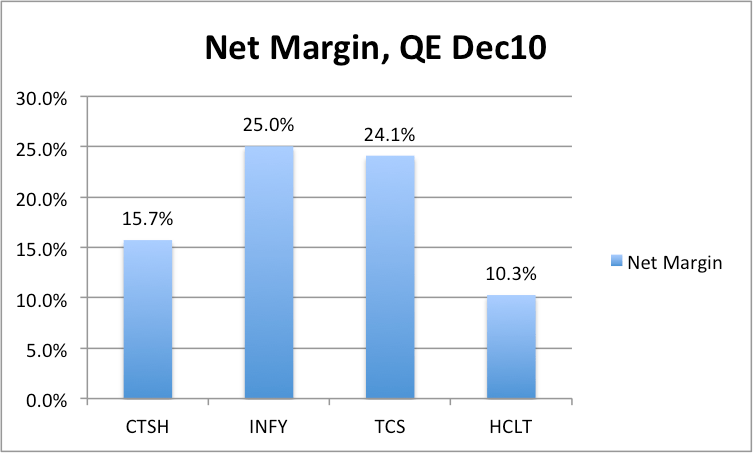 The margins range from 10% for HCL to 25% for Infosys. (Wipro does not report net margins for its IT Business separately.) It is uncommon in an industry to have four similar sized companies in the lead with such a wide range of margins. Especially, in an industry where there are no entry barriers of technology.
My take is that this range of margins will narrow in the long term. Since Cognizant is now the growth leader, it can afford to stay put. But Infosys, TCS and Wipro will find it difficult to stay where they are.
If they execute well, these companies will be able to gradually up their spend on the things that matter and protect pricing. If they don’t, their pricing power will erode.
Protecting price levels is all about reducing competition. Superb account management and client service can do that. Investing in solutions that create measurable value for clients can do that. And new services and IP can do that.
Yes, a strong brand will also help, but the leverage from better marketing today, with five major players in the market, is not what it used to be. Good marketing is now table stakes.
On a related note, fellow EI, Ray Wang, who is just back from a NASSCOM conference, has a great post on how Indian services companies can start leading.
Bollywood Music – the Android Opportunity

Can Indian digital music become a legitimate business? Or will it stay stuck with a 20th century distribution model?
You might say that Bollywood is already digital. You already get popular music on iTunes and amazon.com outside India. But the problem is that Apple and amazon.com are force-fitting their template for western music onto Bollywood music.
Take pricing. iTunes pricing for Bollywood songs is its standard 0.99c. Amazon.com is the same, though I saw a few songs for 0.89c. The Dabangg CD costs what? Rs. 150? For 10 songs. That works out to 0.33c per song. And the shame is that the 0.99 pricing is not because the Indian studios want that pricing. It is because Apples forces a standard template on everyone.
There are a bunch of other things that I would expect from a music service that specialized in Indian music. Don’t expect these from Apple or amazon.com. Correcting spellings, for instance. I find the “did you mean ….” in Google is very helpful. But when I am looking for music on iTunes for the movie Awaara, I don’t know how it’s spelt. Aawaara picks up something, so does Awara, but neither is Raj Kapoor’s Awaara, which is what I want. It should be so easy to build an intelligent, forgiving search for spelling Indian movies in English.
Here’s what came up when I was looking for Dabang on iTunes (instead of Dabangg).

Indian popular music is about the movies. The movie is part of the experience of the song. It is also a revenue making opportunity. Sell music videos. The cross sell opportunity between music, music videos and the movie itself is enormous. It is not being leveraged at all today.
I am sure Bollywood executives wonder about how to leverage this opportunity. Indian music is just too different. It’s not just a matter of pricing. Waiting for Apple or amazon.com to wake up to the opportunity is not the answer. So what do they do?
There is a way opening up. Because of Android, 3G and more broadband.
As I write this, I am listening to Shreya Ghoshal on iTunes/MacBook – WiFi – Airport Express – Denon receiver – Polk speakers. But most digital music is consumed through a portable player. The world’s dominant portable music player is the iPod (and the iPhone). The iPod never really caught on in India. Neither did the iPhone. Too expensive. So most of the market comprises of cellphone mp3 players.
Android is going to be big in India. People who own cellphone mp3 players today will have Android phones within 2 years. Android is the perfect platform to build a digital music player for. And its user base will have size and depth.
I think Bollywood should do a Hulu. Two or three leading studios [labels] should come together with a VC and form a company. The company’s mission should be to build a digital music business in India.
There are many models out there that could be candidates. Download with/without DRM (iTunes, amazon.com), Subscription (Spotify), Streaming and ad supported (Pandora). The technology too is mature. Scores of Indians in the Bay Area have the expertise to build digital media systems.
The key challenge is on the deal-making side of things. The ownership of copyright in India is a little more complicated than in the US. Also, the industry is more fragmented. To get a critical mass of copyright owners on board will take a lot of doing. But hopefully, the opportunity ahead is what will convince them to sign up.
Week’s Tweets 2011-02-06
- They have one strategic consideration and that's Israel. | Egypt's revolution is sweet and peaceful | Comment is Free http://bit.ly/i4j9il #
- Remember the plastic cover in tatters on your Dad's Vespa that he wouldn't remove? | The iPhone ‘Condom’ Debate – http://nyti.ms/h7Iwiw #
- The only known case where SMS spam has benefitted humanity | Dumb Luck – The Daily Dish | By Andrew Sullivan http://bit.ly/gtb3Id #
- IIM Ahmedabad ranked 11th! That's amazing! Financial Times – Global MBA Rankings 2011 http://bit.ly/fWkGsS #
- So say we all! | Of Egyptian Protests and Admiral Adama http://t.co/ewlP8SI via @gizmodo #
- CNN/CNBC talking Halle Berry's custody fight. Al Jazeera Live is crashing on OS X. CNBC anchor called Mubarak Musharraf. 🙁 #WeWantOurAJE #
- You can't stop a man who has something to say | Official Google Blog: http://bit.ly/ekhi3r #
- US should start turning the screws on the military | Egypt Endgame | Marc Lynch http://bit.ly/guPlto #
- Sniff, sniff. Smells like Microsoft | Apple Would Be Crazy to Block Use of Outside Content: Gigaom « http://bit.ly/idfjHw #
- Jains 1% of India, contrib 24% of taxes » {Brown Pundits} Jains and wealth http://bit.ly/eqmn5u #
IIM Ahmedabad ranked 11th by FT

The Financial Times has its Global MBA rankings for 2011 out. IIM Ahmedabad is ranked 11th. It was not ranked in previous years. So this is completely out of the blue.
The Economist recently also published their MBA rankings. IIM Ahmedabad was ranked 85th – the only Indian MBA program to be on the list. Which is better than not being on the list, but only just.
So the FT ranking is quite a shot in the arm. I have never had any doubt that my fellow alumni can stand toe to toe with the best. The faculty and research, I know, could improve. But the students are the best anywhere. Yes, they are picky and high maintenance and tend to not fit into every organization. But, at least in part, that is because they are just smarter than the people around them.
OK enough self-serving praise. If IIM A is so hot, how come it didn’t even get a rank till last year?
You have to apply to be ranked, and I don’t know if the institute applied or not. But even so, there are a few things it has ranked high on, which may depend on changes to methodology, and that may have pushed it higher in the rankings.
Take a look at the FT page I have linked to above. It allows some pretty neat analysis on-the-fly.
IIM A has ranked high on Salary Today (3rd) and Weighted Salary (2nd). Since these were computed using PPP (Purchasing Power Parity) it has ranked quite high. It also ranked high on Increase in Salary, before and after the MBA (3rd). Also on Careers and Employment.
Not surprisingly, it ranked low (92nd) on Research and International Faculty (last). It also ranked low on Women in Faculty (12%).
Now, how all this was factored into the final rankings is not something I went into. I expect, Salaries must have had a pretty high weighting in the overall rank computation. Using PPP there, helps a lot, and I would argue is absolutely the right thing to do.
Now if only the institute were freed from the clutches of the government it could do something to attract world-class faculty and focus a lot more on research. Like many things in India (the economy, for instance) IIM Ahmedabad shines, in spite of, not because of its ownership by the Government of India.
[Update: As many readers have informed me, the FT ranking is for the PGP X program which is a 12 month full time MBA that accepts students with considerable work experience (avg 10 years), unlike the PGP program which is a 2 year MBA but accepts many (most?) students straight after college (as I did). The PGP program does not qualify, because of the low work ex requirement, for the FT rankings. The PGP X program, which is new, was ranked for the first time.]